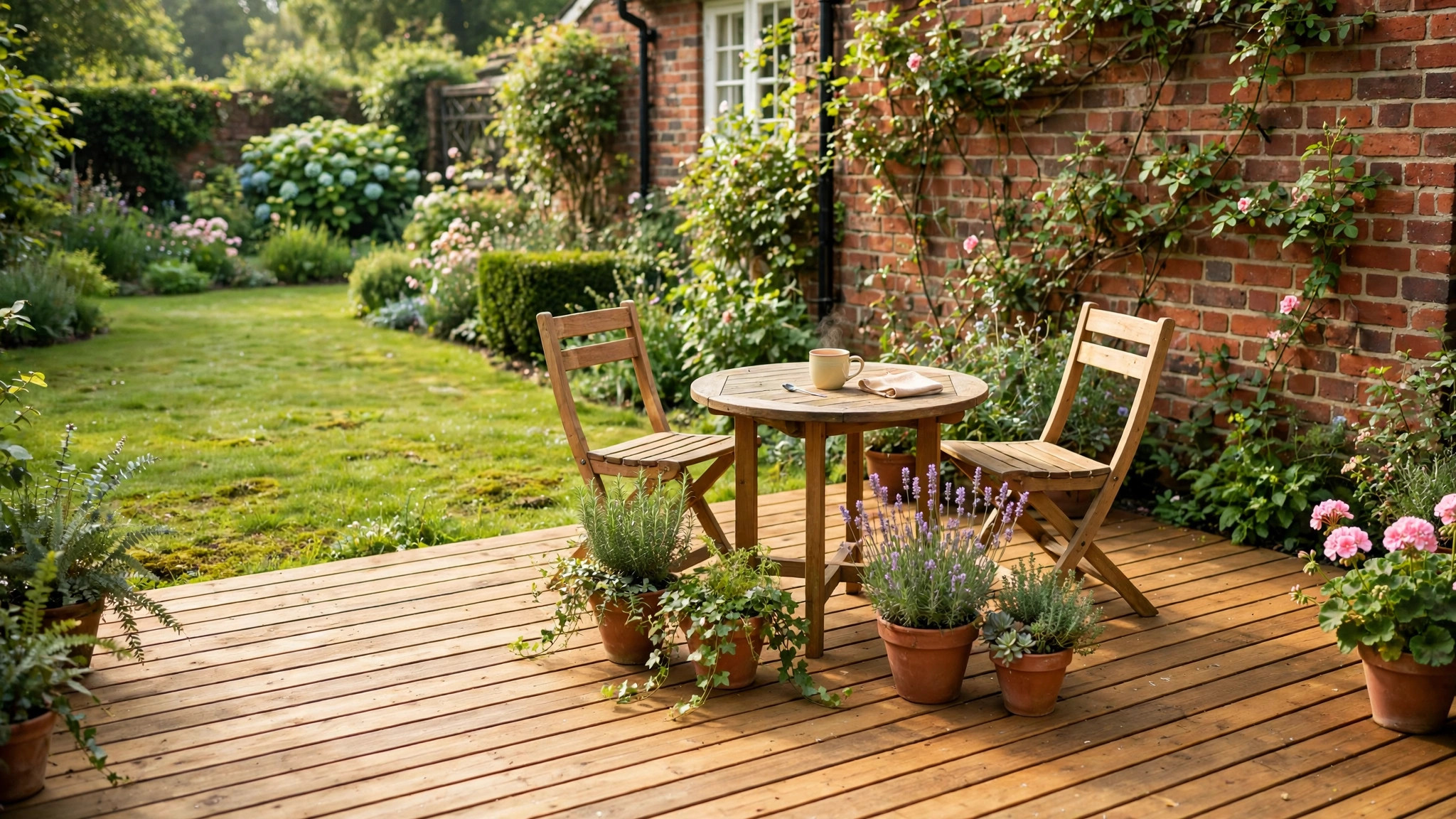
Decking Ideas: 15 Ways to Build a Deck You’ll Actually Use
The best decking ideas start with how you will use the deck, not with the prettiest photo online. In fact, a deck that fits one chair and a morning coffee beats a big deck nobody sits on. So pick one job for your deck first. Eating outside, sunbathing, or a quiet cup of tea. Then build everything around that one job.
At a Glance
- The short answer: the best decking ideas give your deck one clear job, then match the size, boards and layout to that job. A small, well-planned deck beats a big one that fights the garden.
- Typical cost: a small softwood deck of 10–15m² costs £1,200–£3,000 supplied and fitted. Composite costs £150–£250 per m² fitted, so the same deck runs £3,000–£5,000 or more.
- Time: a DIY ground-level deck takes one long weekend for a confident DIYer. A professional team usually finishes a standard deck in 2–4 days.
- DIY or professional: ground-level timber decks suit keen DIYers. Raised decks, slopes and anything over 30cm high belong to a professional.
- Biggest warning: check the 30cm planning rule before you build. A deck over 30cm above the ground needs planning permission in England and Wales.
Which Decking Ideas Suit Your Garden?
The right decking ideas depend on the garden you have, not on the photo you liked best. For example, a small paved yard needs a different deck from a long sloping garden. In short, find your row in the table, then jump to the section that fits.
| Your garden | Start with | Rough cost |
|---|---|---|
| Small paved yard or courtyard | Ideas 1–4 | £800–£2,500 |
| Long, narrow garden | Ideas 1, 2 and 13 | £1,200–£3,500 |
| Sloping garden | Ideas 5–6 | £2,200–£8,000+ |
| Big garden for entertaining | Ideas 7–10 | £3,000–£8,000+ |
| Any garden, if you want style | Ideas 11–15 | £1,500–£5,000 |
How Much Does Decking Cost in the UK?
A deck costs what the boards cost, plus the frame, plus the labour. In fact, the board you choose is the single biggest factor in the price. Therefore, decide on the material before you ask for quotes, or every quote will mean something different.
| Material | Supply and fit per m² | A 15m² deck, fitted |
|---|---|---|
| Pressure-treated softwood | £70–£120 | £1,200–£1,800 |
| Hardwood (iroko, balau) | £150–£220 | £2,500–£3,500 |
| Composite (capped) | £150–£250 | £3,000–£5,000+ |
| Premium composite (Millboard, Trex) | £220–£350 | £3,500–£5,000+ |
These 2026 UK figures cover the decking ideas in this guide. They come from Pricing Penguin’s decking cost guide, and they assume a flat garden with easy access. However, three things push the price up fast. A slope adds 15–30% to the frame cost, because the posts and footings get deeper and heavier. Steps and a balustrade add £500–£1,500. And poor access, where boards must be carried through the house, adds labour hours.
What does decking cost over ten years?
The cheapest deck is not always the cheapest over time. Softwood needs cleaning and oiling every year. That costs about £3–£6 per m² a year in materials, plus a weekend of your time. Composite needs almost nothing beyond a wash. As a result, a £1,500 softwood deck can cost another £600–£900 in upkeep over ten years. A £4,000 composite deck costs close to nothing extra. In short, work out the ten-year cost, not just the build cost, before you choose.
Do You Need Planning Permission for Decking?
Most garden decking in England and Wales needs no planning permission at all. It falls under permitted development, which means you can build it without applying. However, there are three hard limits, and crossing any one of them means you need permission. The Planning Portal’s decking page sets them out plainly.
First, the deck must be no more than 30cm above the ground at any point. That is the rule that catches most people. It is measured from the highest point of the ground next to the deck, not the lowest. So on a slope, a deck can look low on one side and still be over 30cm on the other. Second, the deck plus every extension, shed and outbuilding must cover no more than 50% of the garden. Third, none of the deck can sit in front of the house, forward of the front wall.
In addition, these rights apply to houses only. Flats and maisonettes have no permitted development rights for decking, and listed buildings and conservation areas carry extra limits. In Scotland, the height limit at the back of the house is 50cm rather than 30cm. Therefore, check your own council’s rules if anything about your home is unusual. Get the answer in writing before you spend a penny.
What about Building Regulations and safety rails?
Planning permission and Building Regulations are two different things. A deck can need no planning permission and still need to be built safely. As a rule, any deck where a fall could hurt someone needs a balustrade.
The usual standard is a rail at least 900mm high, with no gaps wider than 100mm. In practice, that means any raised deck needs a proper rail, not a token one. A raised deck is also a structural job. It needs proper posts, concrete footings and load-bearing calculations, so it is not a DIY project.
Timber or Composite Decking: Which Is Better?
There is no single right answer for these decking ideas. Timber is cheaper, warmer underfoot and easier to repair, because you can swap one board. Composite costs more, but it never needs oiling, never splinters, and holds its colour for years. Therefore, the choice comes down to money now versus time later.
| Softwood timber | Composite | |
|---|---|---|
| Cost per m² fitted | £70–£120 | £150–£250 |
| Yearly upkeep | Clean + oil, £3–£6 per m² | Wash only, almost free |
| Lifespan with care | 10–15 years | 25–30 years |
| Feel underfoot | Warm, natural | Can get hot in sun |
| Slippery when wet | Yes, without treatment | Less so, but still needs cleaning |
| Repairs | Swap one board | Harder to match colour later |
Hardwood sits in the middle. It costs £150–£220 per m² fitted, lasts longer than softwood, and looks beautiful. However, it still needs oiling, and it is heavy to work with. In short, pick softwood if the budget is tight. It suits you if you do not mind a weekend of upkeep each year. Pick composite if you want to build it once and forget about it.
Decking Ideas for a Small Garden
A small garden is where a deck earns its keep. There is no room for a patch of tired lawn and a fiddly patio. One clean surface you actually use is worth more than two half-used ones. These four decking ideas make a tight space feel bigger, not smaller.
1. Run the boards lengthways to stretch the garden
Board direction changes how big a garden feels. Lay the boards lengthways, running away from the house down the longest line of the garden. The eye follows them. As a result, the garden feels longer than it is. Run them across instead, and a narrow garden feels wider. Either way, the trick costs nothing, because the boards cost the same whichever way they run. However, decide the direction before you order, since the frame joists run the opposite way.
2. Give the deck one clear job, not three
A small deck that tries to be a dining area, a sun lounger and a play space fails at all three. Instead, pick one job. If you eat outside most, put the table on the deck and keep the chairs there all summer. If you want a quiet corner, put one bench and one pot there. Leave the rest of the garden alone. In fact, a deck with one clear purpose always looks calmer than a deck crammed with furniture. Our guide to 15 small garden ideas uses the same rule for the whole garden. It works just as well for one deck.
3. Build the bench into the deck
Freestanding furniture eats a small garden. A table and four chairs can fill half a small deck, and then nobody can move around them. Instead, build a bench along one edge of the deck, or across a corner.
A built-in bench costs £80–£200 in timber if you build it with the deck. It frees the middle of the deck completely. In addition, the space under the bench becomes storage for cushions and the watering can. Above all, measure before you build. Leave at least 60cm behind a dining chair, so people can sit down without scraping the wall.
4. Pick pale boards to open the space up
Colour matters more in a small garden than in a big one. Lighter boards bounce more light around. Shades like pale grey, light oak or natural pine make a compact space feel open and airy. Dark boards look smart and expensive in a big garden. In a small shady yard, though, they can close the space in. However, pale boards show dirt faster, so they need a wash more often. In short, if your garden is small and shady, go pale. If it gets full sun all day, a mid-tone board is the safer pick.
Decking Ideas for a Sloping Garden
Sloping gardens are where decking beats paving. Levelling a slope for a patio means digging, retaining walls and concrete. That costs more than a deck frame on posts. A deck simply floats over the slope. These two decking ideas turn a slope from a problem into the best seat in the garden.
5. Build a split-level deck with zones
A slope is a gift if you use it. Build the deck in two levels, with a step or two between them. Each level gets its own job. For example, put dining on the top level near the house. Put a quiet seating area on the lower level, where the view opens up. Split-level decking ideas work because each level feels like a room, and rooms make a garden feel planned.
However, a split-level deck costs more than a flat one. A single raised timber platform of 20m² on a gentle slope runs about £2,200–£3,200 in 2026. A multi-level composite deck of 40m² on a steeper slope can reach £7,500–£12,000. In addition, anything over 30cm high needs planning permission. Check the rules in the section above before you commit.
6. Use wide, shallow steps instead of a ladder
Narrow steep steps make a deck feel like a fire escape. Wide shallow steps do the opposite. They invite you down into the garden, and they double as extra seating when friends come round. Therefore, build steps at least 90cm wide. Keep the tread depth at 25–30cm and the rise at no more than 17cm. In fact, two wide steps cost little more than one narrow flight, because the timber is the same. Above all, put a handrail on any step down to a lower level. Add anti-slip strips to the step edges before the first wet autumn.
Decking Ideas for Eating and Relaxing Outside
A deck earns its money in the evenings. These four decking ideas turn a flat patch of boards into the place everyone gathers. Think first barbecue in May, last glass of wine in September.
7. Put the dining deck right by the back door
The most-used deck is the one closest to the kitchen. Nobody carries plates, glasses and a salad bowl 20 metres down the garden in the rain. Instead, build the dining deck directly outside the back door. Make it big enough for the table plus 60cm of space behind every chair. A 3m by 3m deck fits a four-seat table comfortably. A 4m by 3m deck fits six. However, keep the deck surface at least 150mm below the damp-proof course of the house. That stops rainwater bridging into the wall. That one detail saves expensive damp repairs later.
8. Add a pergola or a sail for shade and shelter
A bare deck is unusable in the midday sun and in a shower. A pergola or a shade sail fixes both, and it turns the deck into a room with a roof. A simple timber pergola costs £300–£1,500 depending on size, and a shade sail costs £40–£150.
In addition, a pergola gives climbers something to grow on. A jasmine or clematis over a pergola smells wonderful on a warm evening and costs £8–£20 a plant. Above all, check the height before you build. A pergola over 2.5m tall can need planning permission, so keep it low and simple.
9. Light the deck for the evenings
A deck with no light dies at dusk. With light, it lives until bedtime. Solar string lights cost £10–£25 a set, and solar stake lights cost £1–£3 each. Put them along the deck edge, around the seating area, and one or two in the darkest corner. However, solar lights need daylight to charge. Put the panel in the brightest spot you have, even if the lights hang in shade.
In addition, warm white light looks far better than cold blue-white outside. It feels like candlelight, not a car park. For a deck you use every evening, mains-powered deck lights set into the boards cost £150–£400 fitted. They are worth it.
10. Build a corner for the hot tub
A hot tub on a deck is the classic British garden dream. It is also the classic expensive mistake. A filled hot tub weighs a tonne or more, and a standard deck frame will not hold it. Therefore, the frame under a hot tub needs deeper posts, closer joists and proper footings. That adds £500–£1,500 to the build.
In addition, put the tub in a corner, not the middle, so the rest of the deck stays usable. A hot tub corner also needs privacy. Plan a screen or tall planting on the overlooked side before the tub arrives, not after. Above all, never put a hot tub on a deck that was built for people only. Get the frame checked by a professional first.
Decking Ideas That Add Style
Once the size and the job are settled, the details make the deck look expensive rather than thrown together. These five decking ideas cost little extra. Yet they are the difference between a deck that looks finished and one that looks like a pallet.
11. Frame the deck with a picture-frame border
A picture-frame border is a band of boards laid around the edge of the deck. They run at right angles to the main boards. It gives the deck a clean outline and hides the cut ends of the boards. The whole thing looks designed rather than assembled.
In fact, the border costs very little extra timber, because it uses the same boards in a different direction. However, it takes a little more time to fit, so a fitter may add £100–£200 to the labour. In short, it is the cheapest way to make a deck look like it cost twice as much.
12. Curve the edge of the deck
Straight edges are easy. A gentle curve softens a deck and makes it feel made for the garden, not dropped onto it. A curved edge works best on the side away from the house. There it flows into the lawn or the planting. However, curves cost more. The boards need cutting to a template, and the frame needs more joists. Expect to pay 10–20% more than a square deck of the same size. In addition, keep the curve gentle. A tight curve is hard to build and hard to sit on.
13. Lay a boardwalk path to the bottom of the garden
A deck does not have to be one big platform. A narrow boardwalk, 90cm wide, runs from the back door to the bottom of the garden. It turns a muddy winter path into a dry walk all year. In fact, a boardwalk is one of the cheapest decking ideas, because it uses so little timber.
A 10-metre boardwalk costs about £400–£800 in softwood. However, a boardwalk needs the same care as a deck. It must sit on a proper frame with air underneath. Without that, the boards will rot from below within a couple of years.
14. Build planting into the deck
A deck surrounded by bare boards looks hard and hot. Planting softens it. Build a planter box into one corner of the deck. Or leave a square hole in the boards for a small tree to grow through. A built-in planter costs £50–£150 in timber and soil, and it frames the deck with green instead of fence. For autumn colour in deck planters, try hardy chrysanthemums.
They flower from September into November and cost £3–£6 a plant. Our guide to growing chrysanthemums in the UK explains which types come back each year. In addition, planters stop people walking off the edge of a low deck, which is a quiet safety bonus.
15. Mix decking with lawn for a softer garden
A garden that is all deck feels like a car park. A garden that is all lawn feels like a field. The best gardens mix the two. Put the deck where you sit and eat, and keep lawn where you walk and play. In fact, most UK gardens work best with about half planting and half hard surface.
A deck-plus-lawn mix is the easiest way to hold that balance. However, keep the deck and the lawn at the same level. Otherwise the mower will catch the deck edge every single week. A flush edge, with the deck boards sitting just above the grass, looks tidy and mows clean.
How Do You Stop Decking Going Slippery?
Slippery decking is the number one complaint about British decks. It is also the most ignored problem in the decking articles that sell boards. The UK gets about 159 rain days a year, according to the Met Office. A deck that never fully dries grows algae, moss and mould. That green-black film is what makes a deck dangerous underfoot, especially in autumn and winter. It ruins even the best decking ideas.
The fix has three parts, and none of them is expensive. First, sweep the deck every week in autumn. Fallen leaves hold moisture against the boards and feed the algae. Second, clean the deck twice a year, in spring and early autumn.
Use a specialist decking cleaner that kills algae spores. A bottle costs £8–£20 and covers a standard deck. A pressure washer helps, but use the lowest setting and work along the grain. Otherwise you will rough up the boards and make them hold more water.
Third, oil the timber once a year with a decking oil, ideally an anti-slip one. Osmo’s anti-slip decking oil, for example, is made to be reapplied once a year. It contains a biocide that discourages moss and algae. In addition, never use rock salt or ordinary ice melt on a timber deck in winter. Both damage the wood and make the surface more slippery over time. If you need grip in a frost, use a product that says it is suitable for timber. For the full winter routine, see our guide to preparing your garden for winter. It covers the jobs to do before the cold arrives.
Mistakes to Avoid With Decking
Most decking ideas fail the same way, and it is not bad luck. They are the same few mistakes, made at the build stage, that show up two winters later. Here are the ones to avoid.
- Building the deck tight against the house. The deck must sit at least 150mm below the damp-proof course, with a gap for air and drainage. A deck that touches the wall traps water against the brick, and damp follows.
- No airflow underneath. A deck needs air flowing beneath it, or the frame rots from below. Never lay boards straight onto soil or concrete with no frame and no ventilation. A ground-level deck needs at least 100mm of clear air under the boards.
- Skipping the weed membrane. Without a membrane under the deck, weeds grow up through the boards within a season. A roll of membrane costs £10–£20 and takes ten minutes to lay.
- Forgetting the fall. A deck needs a tiny slope, about 1 in 80, so rainwater runs off instead of pooling. A flat deck holds puddles, and puddles grow algae.
- Cheap screws and fixings. Ordinary screws rust, stain the boards and pop up underfoot. Stainless steel or coated decking screws cost more, about £15–£30 a box, but they stay put for the life of the deck.
- Raising the deck without permission. A deck over 30cm high needs planning permission. Building first and asking later can mean taking the whole thing down. Check the rules in the planning section above before you build.
What I’d Do in My Own Home
If I were building a deck in my own garden tomorrow, I would keep it small. It would be a 3m by 4m softwood deck right outside the back door. It would have a built-in bench along one edge and a picture-frame border. I would oil it the day it was finished, and again every autumn. I have seen too many decks go grey and slippery in one wet winter.
I would not stretch the budget to composite. I would rather spend the saved money on a pergola and proper lighting. Those are the things that actually get you outside on a summer evening. And I would check the 30cm rule with the council in writing before a single post went in the ground. Rebuilding a deck is a cost nobody budgets for.
Conclusion
The best decking ideas are the simple ones. Pick one job for the deck, match the size to that job, and build it low, dry and safe. Check the 30cm planning rule. Choose timber or composite on the ten-year cost rather than the day-one price. And plan for the slippery autumn from the start. Do those things, and your deck will be the part of the garden you actually use.
That is what good decking ideas do — they turn a patch of garden into the place everyone wants to sit. The single most important next step is to measure your garden. Mark out the deck with string and pegs before you order anything. A deck that fits the garden on the ground will fit it in real life too.
Frequently Asked Questions
Q1. Can you lay decking straight over grass?
No, not if you want it to last. Decking laid straight on grass traps moisture, and the boards and frame rot from below within a couple of years. Build a proper frame on posts or pads, with a weed membrane underneath and air flowing below the boards. The extra day of work adds years to the life of the deck.
Q2. Does decking add value to a house?
A well-built deck can help a house sell, because buyers love usable outdoor space. However, there is no fixed percentage, and a poorly built or rotting deck can put buyers off instead. Think of decking as something that makes your home nicer to live in and easier to sell, not as an investment with a guaranteed return.
Q3. Can you build decking in winter?
Yes, you can build in winter, and fitters are often cheaper and easier to book then. However, wet timber is heavy and slippery to work with, and oil or stain will not dry properly below about 10°C. For that reason, build the frame in winter if you like, but wait for a dry spell in spring to oil the boards.
Q4. What should you do with old decking boards?
Do not burn old decking, because pressure-treated timber contains chemicals that release harmful fumes when burned. Instead, take it to your local household waste recycling centre, where most councils accept treated timber. If the boards are still sound, offer them free on a local reuse site. Someone building a planter or a shed will usually take them.
Q5. Can you put decking in a rented garden?
Only with the landlord’s written permission, and most tenancy agreements say the garden must be returned as you found it. A full deck is a permanent change, so landlords usually say no. A freestanding deck on pads, which can be lifted away when you move, is a much easier yes. Ask first, get the answer in writing, and keep the deck small.
Q6. How wide should the gaps between decking boards be?
Leave a gap of 5–8mm between boards, so rainwater drains through and the boards have room to swell in wet weather. Boards fitted tight together trap water, cup and warp, and the deck ends up uneven. Use a spacer, a spare offcut or a couple of coins, to keep every gap the same width along the whole deck.