How to Prepare Your Garden for Winter: 12 Jobs That Protect Your Plants
Winter does more damage to a UK garden than any other season. Frost splits pots and kills tender plants, wind rocks roots loose, and weeks of rain turn soil into cold mud that rots bulbs and roots. The good news is that a weekend of simple jobs in November protects almost everything — and makes spring much easier.
This guide walks you through the 12 jobs that matter most, in the order to do them. None of them needs skill or expensive kit. Most cost nothing at all, and the whole list can be done in one weekend in a small garden.
At a Glance
- The big three: mulch the borders, protect tender plants, and look after your pots — these stop most winter damage
- Cost: £0–£30 (fleece, one or two bags of mulch, a tap cover)
- Time: one weekend for a small garden, less if you only do the big three
- Do not skip: draining hoses and covering the outdoor tap — one burst pipe costs more than every job on this list together
- Beat the first frost: the first frost usually arrives in mid October to early November. Gardens in the south get it a few weeks later than gardens in Scotland, so treat the dates as a guide, not a rule. Do the frost jobs — tender plants, pots, taps — before it comes.
Job 1: Clear the Leaves — But Not All of Them
Rake leaves off the lawn and paths. Left on grass, they block the light and the grass underneath dies in yellow patches. Left on paths, they turn into a slippery film after the first frost. But do not treat every leaf as rubbish: pile leaves in a corner, under a hedge or behind the shed, where hedgehogs and insects shelter in them all winter. Leaves on the borders can stay too — worms pull them down and feed the soil. Clear the lawn and the paths, leave the rest.
If you want free compost, make leaf mould. Stuff damp leaves into a bin bag, poke a few holes in it, and leave it in a corner. Most leaves take about two years to rot down fully, but the result is the best soil improver you will ever get for nothing.
Job 2: Mulch the Borders
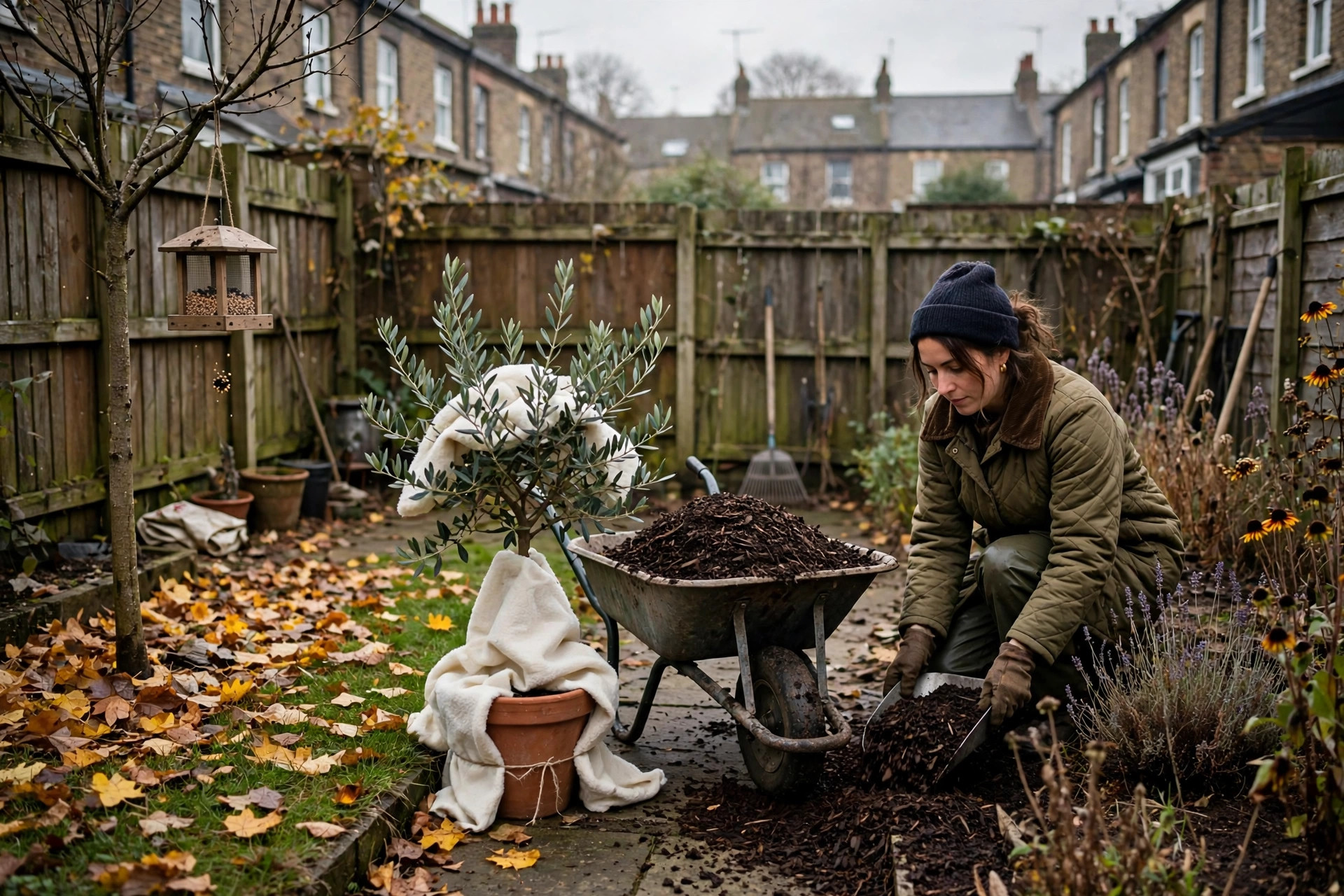
Spread a thick layer of mulch — compost, bark or well-rotted manure — over the borders, about 5–8cm deep, around plants but not touching their stems. Mulch works like a blanket: it holds warmth in the soil, stops hard frost reaching roots, and stops heavy rain washing the soil away. A bag of bark mulch costs about £6–£8 and covers roughly a square metre at this depth. If money is tight, mulch the plants you love most and leave the tough ones — most hardy shrubs honestly do not care.
Job 3: Protect Tender Plants With Fleece
Some plants cannot take a hard frost: dahlias still in the ground, olive and citrus trees, cordylines, young lavender, and anything Mediterranean. Wrap them loosely in garden fleece (£5–£10 a roll from any garden centre) when a hard frost is forecast, and tie it gently — fleece keeps frost off while letting air and light through, which plastic sheeting does not. Dahlias in cold or wet areas are safer lifted: dig up the tubers after the first frost blackens the leaves, dry them for a week, and store them in a box of dry compost in a shed or garage.
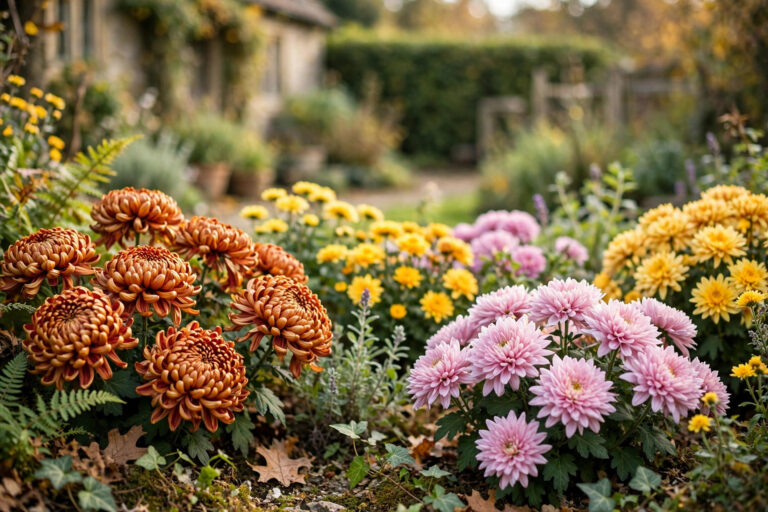
Lift other tender bulbs and tubers the same way — cannas, begonias and gladioli will not survive a hard UK winter in the ground either. Shake the soil off, dry them for a few days, and store them somewhere frost-free. Hardy chrysanthemums are different: they can stay outside with a mulch over the roots, and our guide on how to grow chrysanthemums in the UK explains how to overwinter them step by step.
Job 4: Look After Your Pots
Pots suffer most in winter because the roots sit in cold, wet compost with frost attacking from every side. Move pots into a sheltered spot — against a house wall, under a table, or grouped together in a corner, where they shield each other. Wrap terracotta pots in bubble wrap or hessian (£8 a roll), because terracotta absorbs water and cracks when it freezes. Raise every pot on feet, bricks or pieces of wood so water drains away instead of sitting in the saucer and freezing around the roots.
Job 5: Plant Bare-Root Plants and Last Bulbs
November is prime planting time for bare-root roses, hedging and fruit trees — they are cheaper than potted plants (£8–£15 for a bare-root rose) and settle in over winter while the soil is still warm enough for roots to grow. It is also the last sensible month for tulips, which actually prefer late planting because cold soil lowers their disease risk. Daffodils should already be in; if you still have a bag in the shed, plant them anyway — late daffodils flower late, but unplanted ones never flower at all.
Job 6: Tidy — But Do Not Over-Tidy
Cut back dead and flopping growth, stake tall plants that the wind will rock, and remove anything rotten or diseased. But leave seed heads standing where you can: goldfinches feed on them, insects hide in the hollow stems, and frost on seed heads is the prettiest thing in a winter garden. Roses get a light trim now — shorten long stems by about a third so wind cannot rock the roots loose — and save the proper pruning for late winter. A tidy garden is fine; a stripped garden helps nobody.
Job 7: Care for the Lawn One Last Time
Give the lawn its final cut, with the mower blades set higher than usual — long grass handles frost better than a shaved lawn. Spike waterlogged areas with a garden fork to help drainage, and brush worm casts off rather than treading them in. Then the golden rule for winter: keep off the grass when it is frosty. Footprints on a frozen lawn crush the frozen leaves of the grass and leave yellow marks that stay until spring.
If you have not fed the lawn yet, give it an autumn feed now — one that is low in nitrogen and high in potash and phosphorus. It toughens the grass for winter instead of pushing soft growth. Do not scarify or aerate now, though: that is a September and October job, while the soil is still warm. By November the grass has stopped recovering, so leave it until spring.
Job 8: Protect Pipes, Taps and Hoses
This is the job that saves real money. Drain garden hoses and bring them under cover — water left inside freezes, expands and splits them. Fit a foam tap cover over the outdoor tap (£5–£10) or wrap it in an old towel inside a plastic bag, and if your tap has its own indoor stopcock, turn it off for winter. A pipe that bursts in a cold snap costs hundreds to fix and can flood a kitchen; ten minutes with a tap cover prevents the whole thing. If spring arrives and your taps run weakly afterwards, a pipe may have been damaged — our guide on how to improve water pressure in your home explains how to check.
Job 9: Clean and Store Your Tools
Clean soil off tools, dry them, and wipe metal blades with an oily rag so they do not rust over winter. Sharpen secateurs and shears now, while there is time, instead of on the first busy day of spring. Drain petrol from the mower or add fuel stabiliser, and clean the grass from underneath it. Tools stored clean and dry last for years; tools left in a damp shed corner are blunt and rusty by March.
Job 10: Clean and Insulate the Greenhouse and Cold Frames
If you have a greenhouse, wash the glass inside and out on a mild day. Clean glass lets in far more of the weak winter light, and washing removes the algae and pest eggs that would otherwise start spring early. Clear gutters on sheds and greenhouses too — a blocked gutter dripping down one wall all winter rots the wood and floods the corner bed below it.
Then insulate it. Line the inside with horticultural bubble wrap, clipped to the glazing bars — it cuts heat loss by about half. An unheated, uninsulated greenhouse is only 2–3°C warmer than outside, so if you keep pelargoniums, fuchsias or citrus in there, add a small heater and hang a max-min thermometer where you can see it. Aim to keep the inside above 5°C all winter.
Job 11: Check Fences, Furniture and Water Butts Before the Storms
Winter storms find every loose fence panel. Push each panel and post now, while the weather is calm, and fix anything that wobbles — a panel repaired in November costs a screw; the same panel down in January costs a new panel, and maybe a neighbour’s shed window too. Cover garden furniture or bring cushions indoors, and turn empty pots and bins upside down so they do not fill with rain and crack in the frost.
Empty the water butts too, or at least scoop the leaves out of them. Leaves left in a butt turn the water into murky soup, and a full butt can crack if it freezes. Clean it now and it is ready to collect the winter rain.
Job 12: Feed the Birds and Plan the Spring
Put out bird food and keep it topped up — birds that survive your garden in winter repay you by eating aphids and slugs all summer. Then do the nicest job on the list: sit inside with a cup of tea and the seed catalogues. Order seeds in winter while the full choice is in stock, sketch any changes you want for next year, and write down what worked this year while you still remember. Spring-you will be very grateful.
What I’d Do in My Own Garden
If I only had one hour, I would do three things: mulch the border with my favourite plants, wrap the olive tree in fleece, and put the tap cover on. Those three jobs stop the biggest losses — dead roots, a killed tree, and a burst pipe. Everything else on the list makes the garden better; those three stop it getting worse.
Conclusion
Preparing a garden for winter is not about making it perfect. It is about stopping the four things that do the damage — frost, wind, standing water and neglect — before they start.
Work through the list over one weekend: clear and mulch, protect the tender plants and pots, drain and cover anything that holds water, and check the fences before the storms check them for you. Do that, and your garden will sleep safely until spring — and wake up ready instead of ruined.
Frequently Asked Questions
Q1. Can I prune everything back hard now so the garden is tidy for winter?
It is better not to. Hard pruning encourages plants to make soft new growth, and that new growth is exactly what frost kills. Prune lightly now — dead, damaged and wind-rocking stems only — and do the proper shaping cuts in late winter and early spring, when plants are about to grow anyway.
Q2. Should I dig over my empty vegetable beds for winter?
You do not need to. Digging is hard work and disturbs the soil life that does the work for you. A better option is to cover bare veg beds with compost, cardboard or a thick mulch and let the worms pull it in over winter. The bed will be soft, fed and ready to plant in spring, with no digging at all.
Q3. Which pots crack in frost, and which are safe outside?
Plain terracotta cracks most easily, because it soaks up water that freezes and expands inside the clay. Glazed pots resist water better but can still crack in a hard frost. Plastic, metal and fibreglass pots are the safest outside. Whatever the pot, raising it on feet so it drains is the single best protection.
Q4. When should I take the fleece off my plants in spring?
Take it off on mild days so plants get light and air, and put it back on at night if frost is forecast — spring frosts catch more plants than winter ones, because plants have started growing. Keep the fleece in the shed until the middle of May; the last UK frosts often arrive in April, and tender new growth has no defence against them.
Q5. My garden is tiny — which jobs matter most for me?
The same big three, and they take under an hour in a small garden: mulch what you can, protect your one or two tender plants, and cover the tap. Small gardens are mostly pots, so spend your effort there — group the pots together in the most sheltered corner and wrap the terracotta ones.