Wall Panelling Ideas: Types, Costs and How to Fit It in a UK Home
Wall panelling ideas are all about covering a plain wall with wood, MDF or plastic panels so the room gains shape and character. A single feature wall usually costs £150 to £400 in materials if you do it yourself, while a whole room fitted by a carpenter often costs £1,000 or more. Most MDF styles are a fair weekend DIY job. This guide covers the types, the real 2026 costs, the fitting steps, and the one mistake that ruins the whole job.
At a Glance
- What it costs: MDF wall panelling ideas start at about £15 per m² for materials. A fitted feature wall typically costs £340 to £425 all in.
- Time needed: one wall takes most DIYers a weekend. A whole room takes two to three days.
- DIY or professional: MDF shaker and shiplap styles suit a careful DIYer. Bespoke oak and full-height work is a job for a carpenter.
- Biggest warning: never fit wall panelling over a damp wall. Fix the damp first, or the panels will hide it while it gets worse.
What is wall panelling?
Wall panelling ideas all start the same way: fixing shaped boards or mouldings to a wall to give it texture and pattern. It is one of the oldest decorating tricks in British homes. It was used in grand houses centuries ago to keep draughty stone walls warmer. Today, though, it is mostly about looks. A panelled wall turns a flat, plain surface into the feature of the room.
Most of all, the idea suits UK homes well. Many of our houses have small rooms, low ceilings and plain plaster walls. For example, wall panelling ideas add depth without taking up floor space. It hides small cracks, uneven plaster and old filler marks. However, it does not hide damp, and it should never be used to cover a problem you have not fixed.
There are six main types of wall panelling ideas. Each one suits a different room and a different budget. The table below gives the short version. The sections after it explain each type in plain terms.
| Type | What it looks like | Best for | Rough material cost |
|---|---|---|---|
| Shaker (picture-frame) | Flat MDF rectangles on the wall, like empty picture frames | Living rooms, bedrooms, hallways | £15–£25 per m² |
| Slat (acoustic) | Narrow vertical wood strips with gaps between them | Living rooms, TV walls, home offices | £40–£120 per m² |
| Shiplap / tongue and groove | Horizontal or vertical boards that slot together | Bedrooms, kitchens, country-style rooms | £15–£40 per m² |
| Wainscoting | Traditional half-height panels with a dado rail on top | Hallways, dining rooms, period homes | £20–£80 per m² |
| Geometric | Triangles, diamonds or squares in a bold pattern | Feature walls, modern living rooms | £40–£100 per m² |
| PVC panels | Smooth waterproof boards | Bathrooms and kitchens | £20–£30 per m² |
Which wall panelling ideas suit each room?
Start with the room, not the picture you saw online. A style that looks wonderful in a large living room can crowd a small box room. A style that suits a dry bedroom can fail badly in a steamy bathroom.
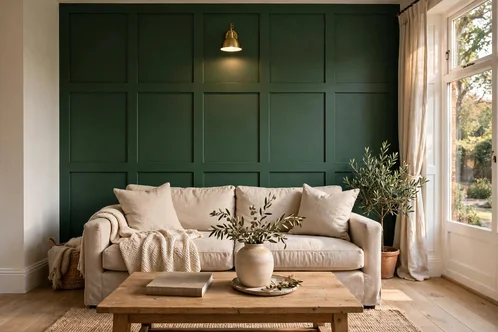
Of all the wall panelling ideas here, shaker is the safest choice. It suits almost every room in the house. The flat rectangles look calm and tidy. They work in a modern flat and in a Victorian terrace. Moreover, they are the cheapest to make, because they are just strips of MDF glued and pinned to the wall. Paint them the same colour as the wall and they look built in. A darker shade turns them into a feature.
Next, slat wall panelling ideas suit a living room or a home office. The vertical strips draw the eye upward, so a low ceiling feels taller. Acoustic versions sit on a felt backing. They are a good pick behind a television or a desk, where they add texture and a finished look.
Shiplap suits a bedroom or a country-style kitchen. The boards give a relaxed, cottage feel. They are also one of the easiest types to fit, because the boards simply slot together. Wainscoting suits hallways and dining rooms best. The half-height panels protect the lower wall from knocks, scuffs and shoe marks. That is exactly what a busy hallway needs.
The bold choice — and the safe starter project
Geometric panelling is the boldest choice. It makes a strong feature wall in a living room. It is the hardest to fit well, because every angle must line up. In fact, if your walls are not straight, and most UK walls are not, the pattern will show it. If you have never tried wall panelling ideas before, choose shaker or shiplap.
How much does wall panelling cost in the UK?
Wall panelling ideas cost from about £15 per m² for basic MDF materials to £160 per m² or more for oak slats. The average fitted job lands at around £225 per m², according to Checkatrade’s 2026 wall panelling cost guide. That average covers materials and labour together. Your own price depends on three things: the material, the size of the wall, and whether you hire someone.
| Type | Materials per m² | Fitted cost for one wall (about 8.5 m²) |
|---|---|---|
| MDF shaker | £15–£25 | about £340 |
| MDF tongue and groove / shiplap | £15–£40 | about £380 |
| Pine slats | £15–£25 | about £340 |
| Oak slats | £120–£140 | about £1,350 |
| PVC bathroom panels | £20–£30 | about £300–£400 |
The figures above come from MyJobQuote’s 2026 cost data, gathered from real quotes given by UK tradespeople. A carpenter typically charges about £45 an hour. Labour is often half the bill. Doing it yourself saves so much.
For example, one UK homeowner panelled a bedroom wall with MDF moulding, about 40 metres of it, and painted it one colour. The panelling itself cost about £280, with paint and sundries taking the room total to about £490. By comparison, the same wall fitted by a carpenter would have cost roughly twice as much. In short, if you own a saw and a spirit level, the DIY route is worth it.
Most importantly, do not forget the extras in your budget. Primer, paint, adhesive, filler and caulk add about £50 to £80 to a feature wall. Paint is the part people forget. Two coats of a good paint on a panelled wall can cost £60 to £120 on its own. A “£150 feature wall” often ends up nearer £250 once everything is counted.
Can I fit it myself?
Most MDF wall panelling ideas make a fair weekend DIY job. You need basic tools, patience and a free weekend. You do not need to be a carpenter. However, you do need to measure twice and cut once. Fortunately, panelling forgives small gaps, because filler and caulk hide them. But it does not forgive a panel fitted at the wrong height.
Draw the layout on the wall. Use a pencil and a spirit level, or masking tape if you want to see the pattern. Next, measure the wall and work out the spacing so the panels are even. Uneven gaps are what anyone notices. Then cut the MDF strips to size. A hand saw works, but a mitre saw is faster and neater.
Fix the strips with grab adhesive and small panel pins. The adhesive does most of the work. The pins hold the strips still while it sets. Fill the joints and the pin holes with filler. Once it is dry, sand it smooth. Run caulk along every edge where the panel meets the wall. This last step matters more than people think. Caulk is what makes the panels look built in rather than stuck on.
Finally, prime the MDF before you paint it. Otherwise, bare MDF drinks paint and goes patchy. One coat of MDF primer stops that. Then paint two coats of your chosen colour. Overall, a whole feature wall usually takes a day to fit and a day to paint, with drying time in between. Keep 10% spare material for bad cuts. Every DIYer cuts one piece wrong.
How do you paint it?
Painting is where a panelled wall succeeds or fails, more than anything else. The panels themselves are only half the job. The colour decides whether the wall looks calm, bold or busy.
Initially, painting the panels the same colour as the wall is the safest choice. The wall gains texture but keeps a calm feel. This works well in small rooms, where a strong contrast can feel heavy. It suits a hallway, where you want interest without fuss.
On the other hand, painting the panels a darker shade than the wall turns them into a feature. For instance, a deep green, navy or charcoal panel wall looks smart behind a sofa or a bed. The contrast shows off the pattern. But it shows every mistake, so your filling and caulking must be neat.
Another option is one colour over everything. Painting the panels, the skirting and the wall in one shade is called colour drenching. As a result, a small room feels bigger, because the eye is not stopped by colour changes. It suits a panelled wall well, since the texture still shows through one colour. A warm white or a soft sage drenched across a panelled bedroom feels calm and finished.
Finally, use a matt or eggshell paint on wall panelling, not gloss. Gloss shows every bump in the MDF. Meanwhile, eggshell wipes clean, which matters in a hallway. Always use MDF primer. Otherwise, the finish comes out patchy because bare MDF takes paint unevenly.
Wall panelling ideas for the bedroom
The bedroom is one of the best rooms for wall panelling ideas. A panelled wall behind the bed works like a headboard, but bigger and cheaper. For example, shaker panels painted the same colour as the wall look calm. On the other hand, slats in a warm wood tone look cosy. Either way, the bed wall stops looking bare.
Overall, half-height panelling suits a bedroom well. In particular, it adds shape without making the room feel smaller. Full-height panelling suits a tall wall, but it can crowd a small box room. Therefore, if your bedroom is small, keep the panels to one wall only. In short, that is enough to change the room.
Bedroom panelling also pairs well with other bedroom ideas. It sits neatly behind the headboard ideas in our bedroom guide, where a panelled wall and a fabric headboard work together. In other words, the panels give structure, and the soft headboard gives comfort. Together they make the bed the clear focus of the room.
Keep the bedroom panels simple. After all, this is a room for rest, not a showroom. For instance, soft colours work best: warm white, sage, dusty blue or a pale grey. Dark colours can work too, but only on one wall. Otherwise, the room can feel smaller at night, when the light is low.
Does it work in hallways and small rooms?
Indeed, the hallway is where wall panelling ideas earn their keep. After all, hallways take more knocks than any other room. Shoes, bags, prams and coats all scrape the lower wall. Half-height panelling protects exactly that part. It also makes a narrow hallway feel finished rather than forgotten.
Wainscoting is the classic hallway choice. Specifically, the panels run to about waist height, with a dado rail along the top. Moreover, the rail itself is useful: it gives a ledge for keys or a picture. In addition, paint the panels in a hard-wearing eggshell so scuffs wipe off. Meanwhile, in a dark hallway, choose a pale colour. Otherwise, dark panels in a hallway with no window can feel like a tunnel.
Similarly, small rooms need the same care. One panelled wall is enough. On the contrary, two panelled walls in a box room can feel cramped. Keep the rest of the walls plain and the colour light.
Measure your hallway before you buy anything. UK hallways are often under a metre wide, and the panels add a few millimetres to each wall. Fortunately, that rarely matters. But door frames, radiators and light switches all get in the way. Instead, plan the layout around them, not through them. For example, a panel that stops at a door frame looks fine. By comparison, a panel cut around a light switch looks like a mistake.
Can you use it in a bathroom?
Yes, but only the right type. Bathrooms are wet rooms. In fact, MDF and wood swell, warp and grow mould when they stay damp. Therefore, never fit MDF wall panelling in a bathroom, however well you paint it. In short, the paint will not keep the steam out for long.
Instead, PVC wall panels are the bathroom choice. They are waterproof and wipe clean. Expect to pay about £20 to £30 per m². They slot together like tongue and groove boards. Many people fit them over old tiles to refresh a bathroom without retiling. In a shower area, seal every joint properly — this is the step that matters most. Otherwise, a gap in the seal lets water behind the panel, and then you have the same damp problem in a new form.
On the other hand, solid-core panels are a step up from hollow PVC. They feel sturdier and look better, but they cost more, roughly £40 to £90 per m². In particular, they suit a family bathroom that gets heavy use. Finally, whatever you choose, leave the area around the bath and shower to waterproof panels only. In short, paint and MDF have no place there.
Ventilation matters as much as the panels. For instance, a bathroom with a weak extractor fan will grow mould on any surface, panelled or not. Therefore, check the fan before you spend money on panels. If the mirror steams up and stays steamed, the fan is not doing its job.
Never fit it over a damp wall
This is the most important section in this guide. In fact, wall panelling hides what is behind it. That is its charm. Unfortunately, it is also its danger. For example, if the wall behind the panels is damp, the panels will trap the moisture. As a result, the damp will keep spreading where you cannot see it. Meanwhile, mould will grow behind the boards. Ultimately, by the time you notice, the damage is worse than it would have been.
Therefore, check the wall before you buy a single panel. Specifically, look for dark patches, peeling paint, bubbling plaster or a musty smell. Next, touch the wall after rain. If it feels cold and wet, stop. Find out why it is damp. It could be condensation, a leak, or rising damp. Each one has a different fix. None of them is “cover it up”.
In particular, if you rent, report damp to your landlord in writing before you do anything to the wall. After all, that written record matters. Similarly, in a home you own, get an independent damp surveyor’s report before paying for any treatment. Damp companies sell the cure they diagnose. Therefore, an independent view protects you. Our guide to removing black mould explains the checks in full. Fix the damp, let the wall dry properly, and only then fit the panels.
Mistakes to avoid
Skipping the primer. Bare MDF takes paint unevenly and goes patchy. One coat of primer saves two coats of paint.
Uneven spacing. Measure the gaps between panels before you fix anything. A gap that is 5mm wider at one end is easy to see and hard to unsee.
Fitting over damp. Covered above, but worth saying twice. Panelling over damp is the most expensive mistake on this list.
Forgetting the sockets and switches. Plan the layout around them. Panels that run into a socket look rushed. Move the panel, not the socket.
Choosing the wrong paint finish. Gloss shows every flaw in the MDF. Use matt or eggshell instead.
Panelling every wall. One feature wall changes a room. Four panelled walls in a small room can feel like a box. Leave some walls plain.
Buying too little material. Keep 10% spare for bad cuts and damaged pieces. Running out halfway through a wall means a second delivery and a visible difference in paint batches.
What I’d Do in My Own Home
If I were picking wall panelling ideas for my own home, I would start with one wall in the living room, in shaker style, in MDF. I would paint it the same colour as the wall, so the texture does the work and the colour stays calm. It is the cheapest option, the easiest to fit, and the hardest to get wrong.
I would not start with oak slats. They look wonderful in photos, but they cost about £1,350 for one wall, and they show every uneven cut. I would save that money for the room that needs it most. And I would check the wall for damp first, because a panelled wall that hides damp is a problem I have made for myself. In short, start small, start cheap, and let one good wall prove the idea before doing the rest of the house.
Conclusion
Wall panelling ideas are one of the cheapest ways to change how a room feels. MDF styles start at about £15 per m², a feature wall is a weekend job, and the result keeps looking smart with a fresh coat of paint now and then. Choose the type that suits the room, measure the layout before you cut anything, and never fit panels over a damp wall. If you do those three things, the wall will look like it was always meant to be there.
Frequently Asked Questions
Q1. Can renters use wall panelling?
Yes, with removable types. Peel-and-stick foam or PVC panels come off without damaging the wall, and lightweight slat panels can be fixed with removable adhesive strips. Do not glue or pin MDF to a rented wall without the landlord’s written permission. Anything fixed with adhesive or pins counts as damage in most tenancy agreements, and you could lose part of your deposit.
Q2. Does wall panelling add value to a house?
It can help a sale, but it rarely adds a clear cash value on its own. Buyers notice a well-fitted feature wall, and it makes photos look better. However, estate agents do not price it like a new kitchen or bathroom. Treat it as a way to make your home nicer to live in and easier to sell, not as an investment that pays you back directly.
Q3. How do you remove wall panelling without wrecking the wall?
Score the caulk along the edges with a craft knife, then work a wide scraper or pry bar behind each strip and lever it off gently. Pull the pins out with pliers. The wall will need filling, sanding and repainting afterwards, because adhesive and pin holes leave marks. Budget a full day to remove one wall and make it good again.
Q4. Does wall panelling help with sound or keeping a room warm?
Only a little. Thin MDF panels add almost no insulation, so they will not make a cold room warm. Felt-backed acoustic slats do soften echo in a room with hard floors, which makes it feel quieter. But they are not soundproofing. If the problem is noise from next door or heat escaping through the wall, proper insulation is the fix, not panelling.
Q5. How do you clean wall panelling?
Dust it with a dry cloth or a soft brush, working along the grooves so dust does not settle in them. For marks, wipe with a damp cloth and a little washing-up liquid, then dry it straight away. Never soak MDF panels, because water swells the edges. In a hallway, a quick wipe once a week keeps scuffs from building up.
Q6. How long does wall panelling last?
MDF wall panelling lasts 10 to 15 years or more in a dry room, and often longer if it is painted well. The paint is what wears first, not the panels. A fresh coat every few years keeps it looking new. PVC panels in a bathroom last about as long, but they can yellow over time in strong sunlight. Oak slats last the longest of all, because solid wood can be sanded and refinished.