Headboard Ideas for Small Rooms: A UK Guide to Sizes, Styles and Costs
A headboard can change a whole bedroom in one afternoon. It gives you something soft to lean on at night. It also stops pillows sliding into the gap behind the bed. Above all, it makes a plain box room feel finished and cared for. However, size is the real catch here. In a small room, the wrong choice eats wall space and crowds the bed. In fact, most returns happen because people skip the measuring stage.
Every style below is judged on small-room life, not on looks alone. For example, each one comes with a fitting type, a UK price band, and one honest drawback. In addition, you get a measuring guide, care tips, and the mistakes that catch people out. As a result, you can pick one headboard and order it once. In short, you spend once and sleep better for it.
At a Glance
- Best all-round pick: a slim upholstered panel. Soft to lean on, easy to fit, £100 to £300 for a double.
- Cheapest idea: paint. A painted headboard costs under £20 and needs no drilling at all.
- Best for renters: strut-fixed styles and stick-on wall panels. Nothing goes into the wall.
- Best for tiny box rooms: wall-mounted panels or a low headboard. Both keep the floor clear.
- Size rule: match the width to your mattress, then check the height against your ceiling.
Start with size: widths, heights and measuring
Good headboard ideas start with a tape measure, not a shopping basket. First, match the headboard width to your mattress width. The table below shows the standard UK widths to look for.
| Bed size | Mattress width | Headboard width |
|---|---|---|
| Small single (2’6″) | 75 cm | 75 cm |
| Single (3’0″) | 90 cm | 90 cm |
| Small double (4’0″) | 120 cm | 120 cm |
| Double (4’6″) | 135 cm | 135 cm |
| King (5’0″) | 150 cm | 150 cm |
| Super king (6’0″) | 180 cm | 180 cm |
In a small room, however, extra width steals space from bedside tables. Therefore, most small rooms suit a headboard that matches the mattress exactly. Similarly, a small double leaves very little spare wall on either side. In short, exact width is the safe choice for tight rooms.
How tall should it be?
Height matters just as much as width. A low headboard, for example, sits about 60 cm above the mattress and suits box rooms, sloping eaves, and low ceilings. For reading in bed, however, you need real support for your shoulders and head. In that case, choose at least 90 cm above the mattress. In a standard terrace bedroom, though, tall styles can make the ceiling feel lower. As a result, tall styles suit high Victorian ceilings far better. Indeed, new-build box rooms rarely carry them well.
Measure these five things before you order
First, measure the width of the whole bed, frame included. Second, measure from the top of the mattress up to the ceiling. In addition, check where the sockets and light switches sit on the wall. A headboard that covers a socket becomes a daily annoyance. Moreover, swing the bedroom door fully open and note exactly where it lands.
Finally, open any fitted wardrobe doors beside the bed. A wide floor-standing headboard can block a door that opens outwards. After all, five minutes with a tape measure beats a bulky return. If you want a second opinion on sizes, Bedstar’s headboard buying guide lists the same UK widths with fitting advice.
Headboard ideas by style: 11 picks for small rooms
The eleven headboard ideas below cover most budgets and most room problems. Some suit renters who cannot drill into walls. Others, for example, suit keen readers, children, or anyone with no room for bedside tables. In addition, each one lists its usual fitting type and price band. Finally, each one names a drawback and a simple fix.
1. Upholstered panel headboard
Of all the headboard ideas in this guide, this is the most popular choice in the UK. A flat padded panel in linen or cotton feels soft and looks calm. For a small room, choose a slim panel rather than a deep, puffy one. Indeed, a slim panel hugs the wall and leaves bedside space alone. Dark fabric, however, can feel heavy in a tiny room. Most panels fix to the bed with struts, so renters can fit one easily. Expect £100 to £300 for a double in most UK shops. The drawback is staining, since fabric marks with daily use. Above all, a washable throw over the top solves that problem neatly.
2. Velvet headboard
Velvet is the cosy option among these headboard ideas, especially on winter nights. In fact, a soft green or blush panel can carry the whole colour scheme. As a result, you need very little else on the walls. For a small room, keep the shape simple and straight. Velvet also shows marks where you lean each night. Therefore, brush it weekly with a soft clothes brush. Besides, that small habit keeps the pile looking fresh for years. Expect £150 to £450 for a double in most shops. The drawback is warmth in summer, but a cotton throw fixes that in seconds.
3. Winged headboard
A winged headboard curves forward at both sides. It wraps the head of the bed a little, like an armchair. Indeed, it feels sheltered and private in a room that never feels cosy. The catch, however, is width. The wings add centimetres on both sides of the bed. Moreover, those centimetres come straight out of your walking space in a tight room. Measure the full width, wings included, before you order. Most winged styles stand on the floor behind the bed. Expect £250 to £600 for a double or king. In short, the drawback is dust along the wing tops, and a weekly wipe fixes it.
4. Slatted wooden headboard
Among wooden headboard ideas, slats are the calmest and simplest option. Vertical slats draw the eye upward towards the ceiling. As a result, a low ceiling feels a little higher than it is. Pale oak and ash keep a small room bright and airy. Dark walnut, however, can shrink a poorly lit room further. Most bolt to the bed frame rather than the wall. In addition, they suit renters for exactly that reason. For example, a damp cloth lifts dust in seconds, and scratches can be sanded and oiled. Expect £60 to £200 for a plain double. The drawback is comfort, since wood is hard to lean on. Two firm cushions fix that at reading time.
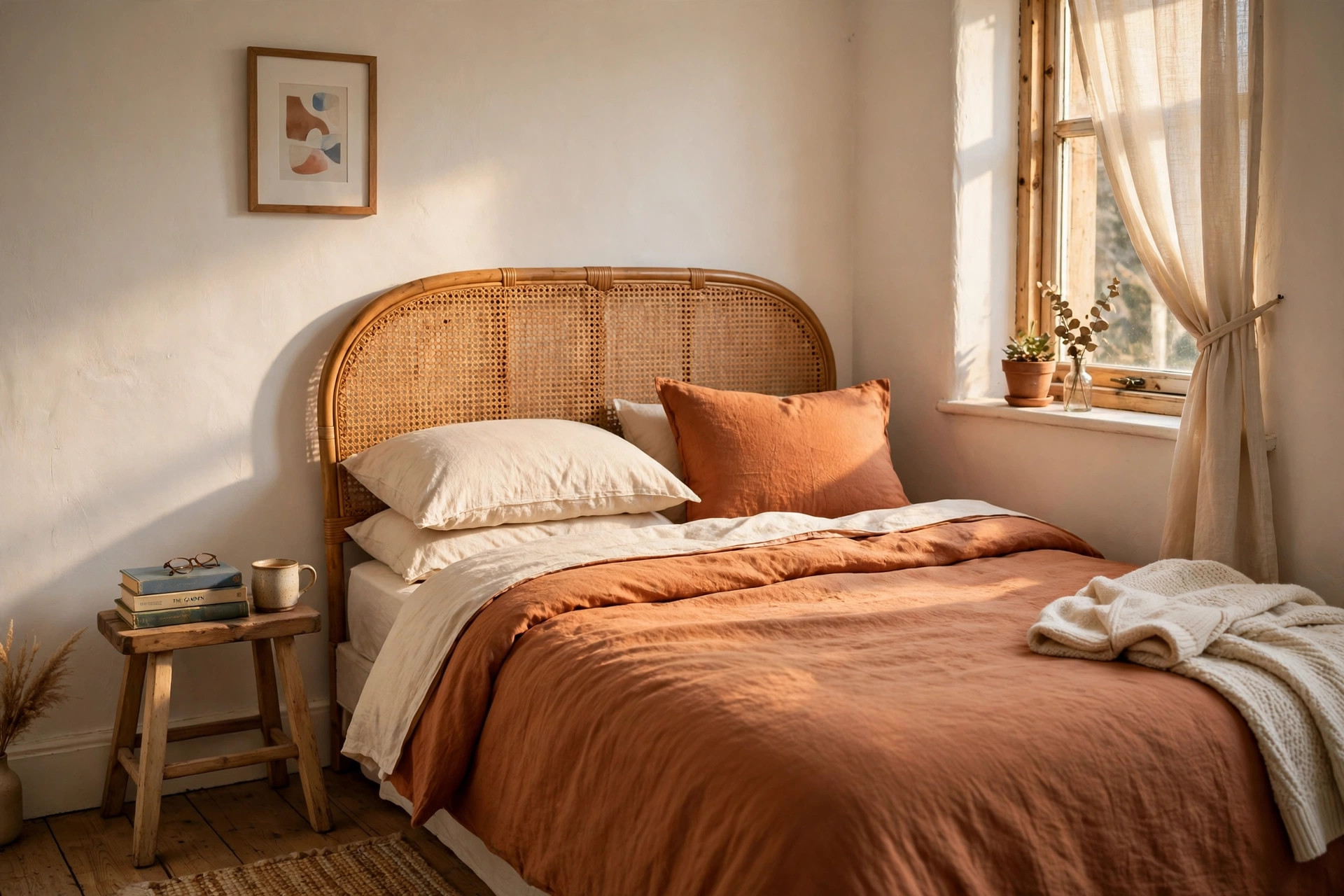
5. Rattan and cane headboard
Rattan is back in fashion across UK homes. The woven pattern lets the wall colour show through behind it. Therefore, the bed wall never feels like one solid block. Rattan suits dry rooms best, though. Damp corners, however, can mark the cane over time. Dust also settles deep inside the weave itself. Similarly, pollen and pet hair cling to the weave in summer. A soft brush once a week keeps it clean. Real cane costs more than synthetic woven panels. Synthetic versions, in fact, wipe clean far more easily. Expect £80 to £250 for a double. Most rattan styles are strut-fixed or floor-standing. The drawback is fragility at the edges. Kept away from boisterous play, however, it lasts for years.
6. Metal headboard
A metal headboard is the lightest-looking style of all. Thin bars leave the wall visible behind the bed. As a result, the room feels bigger than it really is. Black suits modern and industrial rooms best. White, indeed, almost disappears against a white wall. Metal is also the easiest style to keep clean. It does not stain or hold dust like fabric does. Moreover, it survives children’s rooms and busy guest rooms well. Expect £40 to £120 for a double. In short, the drawback is comfort, since metal feels cold against your back. A couple of firm pillows solves that straight away.
7. Wall-mounted padded panels
This is one of the best headboard ideas for a truly small room. Instead of one big headboard, you fix two or three panels in a row. You set the width to match the bed exactly. Above all, the panels sit flat, so they take no floor space at all. Panels solve awkward rooms too. For example, they can stop short of a corner or follow a sloping ceiling.
In addition, many kits include the fixings in the box. Screw-fixed panels hold better than stick-on ones over time. Stick-on kits, however, suit renters who must avoid holes. A double set usually costs £80 to £250. The drawback is alignment, since wonky panels look messy. A spirit level and pencil marks fix that before you start.
8. Headboard with shelves
No room for bedside tables? This style answers that problem directly. A narrow shelf runs along the top of the headboard. It holds a book, a phone, a glass of water, and a small lamp. Keep the shelf shallow, around 15 cm at most. A deep shelf, however, knocks against your pillows all night. Indeed, never overload it with heavy hardback books either. Most stand on the floor behind the bed frame. Expect £120 to £350 for a double. Above all, the drawback is clutter above your head, so a nightly tidy keeps it useful.
9. Painted headboard
The cheapest of all these headboard ideas is paint. You paint a rectangle or an arch on the wall behind the bed. Choose a colour one or two shades deeper than the wall itself. This route suits renters who cannot drill at all. Moreover, it suits walls where no real headboard fits properly.
For example, a radiator or sloping ceiling stops being a problem. An arch shape softens a boxy room nicely. In fact, the whole job usually costs under £20. In short, the drawback is padding, since paint supports nothing at all. A firm cushion against the wall fixes that at bedtime.
10. Low headboard for a loft bed or low ceiling
Not every bed needs height above it. A low panel of 40 to 60 cm protects the wall from scuffs. Above all, this style suits attic rooms and sloping eaves. It is also the natural partner for a raised bed. If your bed sits under a loft bed, a short panel protects the wall without crowding sleepers.
Children benefit from a low panel too. Indeed, it is safer if they climb, and easier for small arms to reach. Expect £50 to £150 for a simple low panel. In short, the drawback is support, since a low panel will not prop you up. Extra pillows handle reading time comfortably instead.
11. Buttoned and Chesterfield headboard
Buttoned styles are the grandest headboard ideas in this guide. Deep buttons and diamond stitching bring a smart hotel feel. In a small room, however, choose shallow buttons over deep ones. Deep padding is thick and pushes the bed into the room. In fact, that lost floor space matters a lot in a box room. Buttons also collect dust over time. Therefore, vacuum them monthly with a brush attachment. Moreover, most buttoned styles are floor-standing or strut-fixed, so fitting stays simple. Expect £200 to £500 for a double. The drawback is bulk, so measure the room depth carefully first.
Looking after your headboard
Care is quick when you match the job to the material. Fabric panels need a weekly vacuum with a soft brush head. Velvet needs a gentle brush in one direction only. In addition, keep velvet out of harsh direct sunlight where you can.
Wood and slats need only a damp cloth and mild soap. Rattan, however, needs a soft dry brush for its weave. Faux leather marks with pen, so wipe spills straight away. In short, ten minutes a month keeps every style here looking new.
Two DIY headboard ideas that cost very little
Ready-made is not the only route worth considering. Two simple projects give you a custom fit for very little money. In fact, each one takes a single afternoon from start to finish.
DIY route one: the painted headboard
First, mark your shape on the wall with painter’s tape. An arch needs a pencil line, a nail, and a loop of string instead. Second, paint inside the lines with a small roller. Two coats usually cover the old colour well. Finally, peel the tape away while the second coat is still tacky. That simple trick leaves a crisp, clean edge behind. The total cost stays under £20 for most rooms. Use leftover wall paint and the cost drops to almost nothing.
DIY route two: a simple upholstered panel
First, buy a plywood board cut to your bed width. Most DIY stores cut boards to size for free. Second, glue a foam sheet, about 5 cm thick, onto the board. Staple wadding over the foam to soften the edges. Then stretch your chosen fabric over the whole panel.
Work from the centre outwards and staple the back every few centimetres. Finally, bolt struts to the bed, or screw two short battens to the wall. Moreover, materials usually cost £40 to £80 in total. That is roughly half the price of a similar shop-bought panel. The finished panel looks far more expensive than it is.
The three ways to fit a headboard
Almost every style here fits in one of three ways. Indeed, the right choice depends only on your bed and your walls.
Strut-fixed. Two struts bolt onto the back of a divan base. In fact, it is the most common method in the UK. It needs no holes in the wall at all. Therefore, it suits renters and anyone who moves the bed often. Check the strut spacing against your divan before you order anything.
Floor-standing. The headboard reaches right down to the floor behind the bed. It needs a flat wall and a little clear floor space. Above all, it suits heavy winged and buttoned styles well.
Wall-mounted. Screws fix the headboard directly onto the wall itself. On plasterboard, however, you must use proper plasterboard fixings. Therefore, ordinary screws will simply pull out under the weight. If you are unsure about your wall type, ask the seller before drilling.
How much do these headboard ideas cost in the UK?
The bands below are rough guides for a double bed. However, sales, size, and fabric quality move prices up or down.
- Metal or simple wooden headboard: £40 to £120
- Slatted wood or rattan: £60 to £250
- Upholstered fabric panel: £100 to £300
- Velvet or buttoned headboard: £150 to £500
- Winged or bespoke headboard: £250 to £600 or more
Fitting is usually free when the headboard bolts to the bed. In addition, delivery is often free from larger UK retailers. Oversized items, however, can carry a charge, so check before you order. Wall-mounted styles may need a handyman instead, which adds £40 to £80. As a result, if money is tight, pair one cheap idea here with a budget bedroom refresh rather than replacing everything at once.
Common mistakes to avoid
Most failed purchases come from the same handful of errors. In fact, all of them need five honest minutes before you order.
Skipping the measuring. Most returns start right here. Indeed, five minutes with a tape measure prevents nearly all of them.
Choosing height by looks alone. A 120 cm panel in a low room presses the ceiling down visually. Therefore, match the height to your room, not to a catalogue photo.
Covering sockets and switches. A beautiful headboard over a socket becomes a daily irritation. Above all, check the whole wall layout before you fall for a width.
Drilling a rented wall. Landlords charge for holes when a tenancy ends. Strut-fixed and stick-on options, however, avoid that bill entirely.
Forgetting the door swing. A wide floor-standing style can block a wardrobe or bedroom door. Therefore, open everything fully while you measure the room.
Buying deep padding for a tiny room. Thick panels push the bed forward and shrink the floor. In short, slim profiles are the small room’s best friend.
How to choose: a quick checklist for small rooms
Work through this list before you buy any of these headboard ideas. In fact, it takes five minutes and prevents the common regrets.
- Measure the bed width and match the headboard to it.
- Measure from the mattress to the ceiling, and keep tall styles for high ceilings.
- Pick a slim profile, since deep padding and wide wings eat small rooms.
- Choose a light colour or an open design if the room is dark.
- Check the fixing type against your bed: struts, floor-standing, or wall-mounted.
- Keep sockets and switches clear of the headboard’s edges.
- If you rent, pick a strut-fixed or freestanding design and drill nothing.
- Match the fabric to the bedding you already own.
If the room already has a strong style, let the headboard follow it. A soft, layered room, like the one in our burrowcore bedroom guide, suits a padded fabric panel perfectly. Above all, the headboard should finish the room, not fight it.
What I’d Do in My Own Home
In my own box room, I would fit slim wall panels in a pale fabric. They take no floor space at all. Indeed, I would spend the savings on better bedding instead. If I rented the room, I would choose a strut-fixed upholstered panel. After all, it moves out with me and leaves no holes behind. In short, I would buy the fit first and the fabric second.
Conclusion
The best headboard ideas for a small room are rarely the most expensive ones. They are the ones that fit the bed, the wall, and the way you sleep. Therefore, measure carefully, pick a slim profile, and match the fixing to your bed. In short, one well-chosen headboard does more than a weekend of decorating.
Frequently Asked Questions
Q1. Can I put a headboard on an ottoman bed?
Yes, in most cases you can. Most ottoman bases carry the same fixing points as a normal divan. On some models, however, the lifting mechanism sits near the back edge. If the points are blocked, choose a floor-standing or wall-mounted style instead.
Q2. Does a headboard help if my bed is against a cold outside wall?
A little, yes. A padded panel puts fabric and foam between you and the cold wall. Indeed, your shoulders feel less of a chill at night. It is not insulation, though, and it will not fix damp. If the wall is damp, sort the damp out first. A panel on damp plaster can trap moisture and turn mouldy behind it.
Q3. How do I stop my headboard wobbling?
First, tighten the strut bolts where they meet the base. In fact, loose bolts cause most wobbles. A tall panel on short struts will always lean a little. As a last resort, add small wall brackets to hold it steady instead.
Q4. Can I use a headboard with an electric adjustable bed?
Yes, but pick the fixing type with real care. A strut-fixed panel can jam against the moving part of the base. Most owners choose wall-mounted or floor-standing styles instead. Above all, a low, slim panel works best when the head end rises often.
Q5. Can I reupholster my old headboard instead of buying a new one?
Often, yes, and it can work out cheaper. A local upholsterer can strip the old fabric and replace flat padding. It works best when the board underneath is still solid. However, if the board is cracked, a new panel usually costs less than the repair.
Q6. Will a headboard fit my IKEA bed frame?
Usually, but check the fixing points first. Many IKEA frames use different bolt spacing from standard UK divans. A strut-fixed headboard may not line up with the holes. Wall-mounted panels and floor-standing styles, however, get around that problem completely.