Loft Bed Ideas for Small Rooms: A UK Guide to Sizes, Safety and Costs
A loft bed can turn the smallest bedroom in the house into a room that finally works. Instead of the bed eating up half the floor, the bed goes up in the air. The space underneath then becomes a desk, a wardrobe or a quiet corner of your own. For UK homes, where the box room is often barely 2 metres wide, that swap can feel like adding a whole extra room.
However, a loft bed is not a buy-it-and-hope purchase. Ceiling height, the age of the sleeper and the safety rails all matter, and getting one of them wrong is an expensive mistake. So this guide walks you through the lot in plain order. First, we will check whether your room is tall enough. Then, we will look at the different types, the real UK costs and the safety rules that actually matter. Finally, we will style the thing so it looks like a bedroom, not a student dorm.
At a Glance
- Best for: box rooms, kids aged six and over, teens, students and adults in small flats
- Space you win back: roughly 2 square metres of floor, the footprint of a single bed
- Ceiling you need: at least 75 cm of clear space above the mattress, and more if you can get it
- Typical UK cost: £150 to £800 for most family lofts, and £600 to £1,500 for solid adult doubles
- Golden safety rule: guardrails on both sides, and no child under six sleeping up top
What Is a Loft Bed, Exactly?
A loft bed is a bed raised high on posts or a frame, with open space underneath it. Unlike a bunk bed, there is no second bed below. Instead, that lower space is free for furniture, storage or a desk. In other words, the bed uses the air in the room rather than the floor. Most small rooms have far more air going spare.
Also, the idea suits UK homes very well. Many terraces and semis have one tiny bedroom that fits a single bed and nothing else. A normal bed in that room leaves no space for homework, getting dressed or even walking around comfortably. In contrast, a loft bed lifts the sleeper up and gives the floor back to daily life. As a result, the same small room can hold a bed, a desk and clothes storage all at once.
First, Measure: The Ceiling-Height Maths
Before you fall for any design, grab a tape measure. In fact, more loft beds fail on ceiling height than on anything else, and the shops rarely shout about it. After all, the sleeper needs enough room to sit up in bed without cracking their head, and that room comes out of your ceiling height.
Most UK homes have ceilings around 2.4 metres high. A typical high loft bed puts the top of the mattress at about 1.6 metres. That leaves roughly 80 cm above the mattress, which is workable, although it is not generous. For a child, 75 cm of sitting space is about the lowest sensible limit. For a tall teenager or an adult, aim for 85 to 90 cm instead, or every bedtime will feel like climbing into a shelf.
The Simple Formula to Check Your Room
Work through these three steps before you order anything. First, measure your ceiling height in centimetres. Second, subtract the height of the bed frame up to the top of the mattress. Use the mattress top, not the frame top, because that is where the sleeper actually sits. Third, look at what is left. If the answer is under 75 cm, a high loft is the wrong buy for that room.
Meanwhile, check the low points too. Ceiling beams, sloped corners and hanging light fittings all steal height in older UK houses. Measure at the exact spot where the bed will stand, not in the middle of the room. Otherwise, you may find the one low corner is exactly where the bed has to go.
The Main Types of Loft Bed
Loft beds come in three rough heights, and the height decides everything else. The right choice depends on the sleeper’s age and what you want to put underneath. In short, here is how they compare in plain terms.
Low loft beds and mid sleepers sit about 110 to 130 cm high. The space underneath is too low for a desk chair, but it works well for storage boxes, a den or a pull-out play area. Because the climb is short, these suit younger children who are not ready for a full-height bed. Indeed, for a first raised bed, this is usually the safest start.
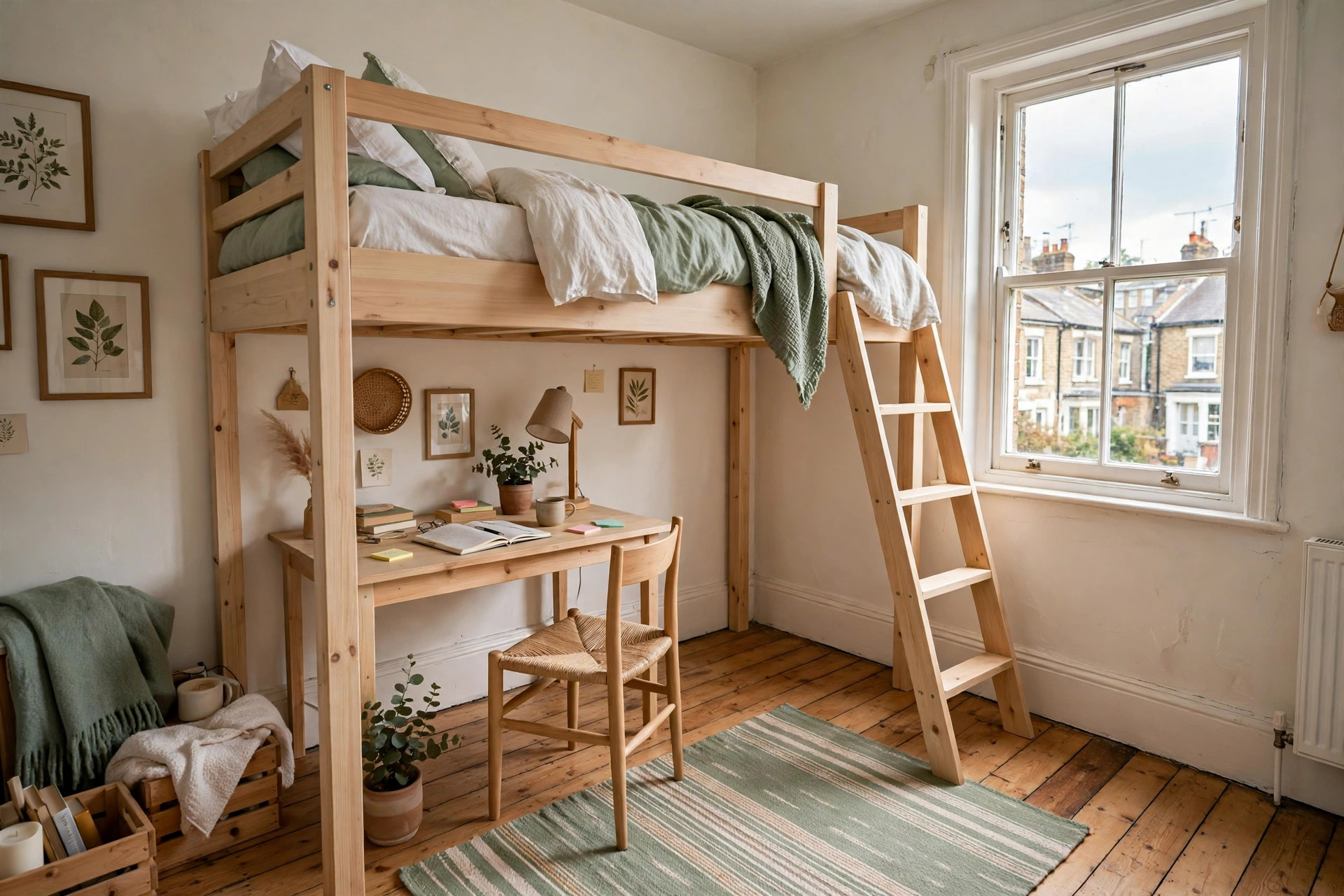
High loft beds stand around 170 to 200 cm tall overall. Underneath, there is usually 140 cm or more of clear height. That is enough for a desk and chair, a small sofa or a wardrobe. Therefore, these suit older kids, teenagers and adults who need the floor space to earn its keep.
Adult and double lofts are built stronger, with thicker posts and higher weight limits. They often cost more, but they open up studio flats and spare rooms in a way a single never could. Some joiners also build them to measure, which helps in rooms with awkward corners or chimney breasts.
Which Height Suits Which Age?
For children under six, skip the raised bed altogether and wait. From about six to ten, a low loft or mid sleeper gives the fun of climbing up without the long drop. Then, from eleven onwards, most children can handle a high loft happily, as long as the safety rules below are followed.
Moreover, think about how long the bed needs to last. A mid sleeper bought for a seven-year-old may feel babyish by twelve. In contrast, a plain high loft with a desk underneath can carry a child from ten to eighteen without a second purchase. Buying once, at the right height, usually works out cheaper in the end.
What Goes Underneath? Making the Space Earn Its Keep
The whole point of a loft bed is the space underneath, so plan it before the bed arrives. Otherwise, an empty gap under a bed quickly becomes a dumping ground for laundry and lost shoes. A planned one becomes the hardest-working corner of the room. Here are the options that work best in real homes.
First, the classic choice is a desk. A loft with a built-in desk turns a box room into a study-bedroom, which is gold for teenagers facing exams. If the room is really tight, our guide to small home office ideas shows how little space a working desk corner actually needs. Just check the clear height under the frame, because a seated teenager needs about 140 cm to sit without stooping.
Second, storage often beats a desk for younger children. Drawers, a low wardrobe or open shelves under the bed can swallow clothes, toys and school bags in one go. As a result, the rest of the room stays clear, and tidying up becomes a five-minute job instead of a weekend project.
Finally, do not overlook the cosy option. A small rug, a cushion pile and a lamp turn the under-bed space into a reading den that children genuinely love. It costs very little, and it gives them a hideaway that feels like their own private world.
How Much Does a Loft Bed Cost in the UK?
Indeed, prices vary a lot, so it helps to know the rough bands before you shop. Simple metal-frame loft beds start at about £150 to £250. They do the job, although they can creak and they rarely feel like furniture you will keep for years. At the other end, solid pine and hardwood lofts from UK makers run from about £500 to £900 for a single. They feel far sturdier, too.
Models with a built-in desk or storage usually sit in the middle, at roughly £250 to £800. Adult double loft beds cost more again, because the frame has to carry far more weight. Expect £600 to £1,500 for a good one, and more for a joiner-built design made to fit your room exactly.
Also, budget for the extras honestly. A suitable low-profile mattress may be needed if your current one is too thick, and that can add £80 to £200. Delivery and assembly services add a bit more. After all, compare the total with the cost of a bigger house or an extension. A loft bed is one of the cheapest space upgrades a family can buy.
Safety Rules That Actually Matter
A raised bed is safe when it is chosen and used properly, and risky when corners get cut. In fact, the rules are simple, and most of them come down to checking a few numbers before you buy.
First, the age rule. RoSPA advises that no child under six should sleep on a top bunk or a raised bed. Younger children climb before they think, and most accidents happen during play rather than sleep. So treat the bed as furniture, not a climbing frame, and say so clearly from day one.
Second, check the guardrails. There should be a rail on both sides of the bed, even on the wall side. Children can slip into the gap between bed and wall, so the wall side matters just as much. The top of the rail must sit at least 16 cm above the top of the mattress. Also, look for the British Standard mark, BS EN 747, which covers bunk and loft bed safety in the UK.
Third, respect the weight limit. Every frame has one, and kids’ models often stop at 75 to 100 kg. That is fine for one child. However, it is not enough for a parent climbing up for story time as well. Adults should choose a frame rated at 120 kg or more, and never guess if the limit is not stated.
The Mattress Rule Most People Miss
Here is the quiet trap. A thick, luxurious mattress can push the sleeper up so high that the guardrail stops doing its job. Most loft beds need a mattress no thicker than about 15 cm. Many frames also have a mark showing the maximum safe height. Keep the top of the mattress below that mark, always.
Similarly, the mattress must fit the frame snugly. Gaps down the side are an entrapment risk for small children, so measure the frame and match the mattress size to it properly. If in doubt, buy the mattress the maker recommends for that bed.
Styling a Loft Bed So It Looks Like a Bedroom
Let us be honest: a bare metal loft can look like a hostel bunk. The fix is softness and colour, and it does not cost much. Above all, start with bedding, because the bed is now the biggest thing in the room and it sits at eye level. A proper duvet set in a warm colour instantly makes it look intentional rather than temporary.
Then, warm up the space underneath. A lamp with a warm bulb, a small rug and one or two cushions stop the under-bed area feeling like a cave. If you love the soft, layered look, the ideas in our burrowcore bedroom guide work beautifully under a loft bed. The low ceiling of the nook suits that cosy style perfectly.
Also, paint helps more than people expect. Painting the wall behind the bed in a deep, warm shade makes the whole setup look built-in and planned. And if the budget is tight this month, look at our budget bedroom decor ideas. They show how far a bedding swap alone can take a small room.
Finally, add light at both levels. The sleeper needs a small lamp or clip-on light up top for reading. The person underneath needs their own light too. In fact, two cheap lamps will do more for this room than any expensive accessory.
What I’d Do in My Own Home
If I were fitting one in a small UK bedroom, I would start with the tape measure and the ceiling formula, not with shopping. Then I would choose a plain, solid wood high loft with no theme and no gimmicks. Plain frames age with the child instead of against them.
Underneath, I would put a simple desk and one set of drawers. I would leave the last corner free rather than filling every centimetre. After all, rooms need a bit of empty floor to feel calm. I would also spend the mattress money properly, on a slim, firm mattress that keeps the guardrail doing its job.
Above all, I would buy the bed once, at full height, rather than stepping up through two cheaper beds. In my experience, the second purchase is where the real money leaks away.
A Quick Word for Renters
Renters can use loft beds too, because a freestanding frame does not fix to the walls or the floor. However, protect the floor under the posts with pads or a rug, since a loaded frame can mark laminate and wood. Of course, keep the packaging and instructions, because you will thank yourself on moving day.
Just check your tenancy agreement before you buy. A few landlords set weight or furniture rules for upper floors in converted flats. Besides, a quick email to the landlord first is far easier than an argument later.
Conclusion
A loft bed will not suit every home. In a small UK bedroom, though, it can be the single change that makes the room work. Measure the ceiling first, keep at least 75 cm above the mattress, and follow the simple safety rules on rails, mattresses and age.
Then plan the space underneath properly, whether that means a desk, storage or a reading den. Do those things, and you get a bedroom that sleeps, stores and studies in the space of one bed. For a box room that currently does none of those jobs well, that is a very fair trade.
Frequently Asked Questions
Q1. Can you put a loft bed on carpet?
Yes, and carpet is actually kind to a loft bed, because it grips the posts and softens any small sounds. However, thick pile carpet can make a frame feel slightly wobbly at first. In fact, the posts usually settle into the pile within a few days. If the bed still rocks, check that all four posts are pressed evenly into the carpet and that every bolt is tight.
Q2. How long does a loft bed take to put together?
Most flat-pack loft beds take two adults about two to four hours. Solid wood frames with desks and drawers can take longer, sometimes a full afternoon. In addition, build it in the room where it will live, because a finished high loft will not fit through most doorways. Also, keep the Allen key afterwards, as the bolts like a quick tighten after the first month.
Q3. Can a loft bed work in a room with a sloped ceiling?
Sometimes, yes. Put the bed along the tall side of the room. Then check the sitting space at the pillow end, because that is where the sleeper sits up. If the slope cuts the space above the mattress below 75 cm, choose a low loft or a mid sleeper instead. Cottages and loft conversions often need this lower option, so do not force a high frame into a low corner.
Q4. Do loft beds squeak and wobble?
Cheap metal frames can, especially after a year of use. Wooden frames with bolted joints are usually quieter and sturdier. If a bed starts to squeak, the fix is normally simple. Tighten every bolt, check the slats are seated properly, and add felt pads where wood meets wood. A bed that still moves a lot after tightening is telling you something. Therefore, stop using it until it has been checked properly.
Q5. Can two people sleep in a loft bed?
Only if the bed was built for it. Some adult loft beds take a double mattress and are rated for two people. Standard single lofts, however, are made for one sleeper and one weight limit. Never let two children share a top loft for a sleepover, however much they beg. The floor, a spare duvet and a film are a safer sleepover plan.
Q6. Will a loft bed make the room feel darker?
It can, a little, because the raised bed blocks some light from the window. The easy fixes are pale bedding, a mirror on the opposite wall and a warm lamp underneath the frame. In practice, most families stop noticing within a week. In short, the extra floor space matters more.