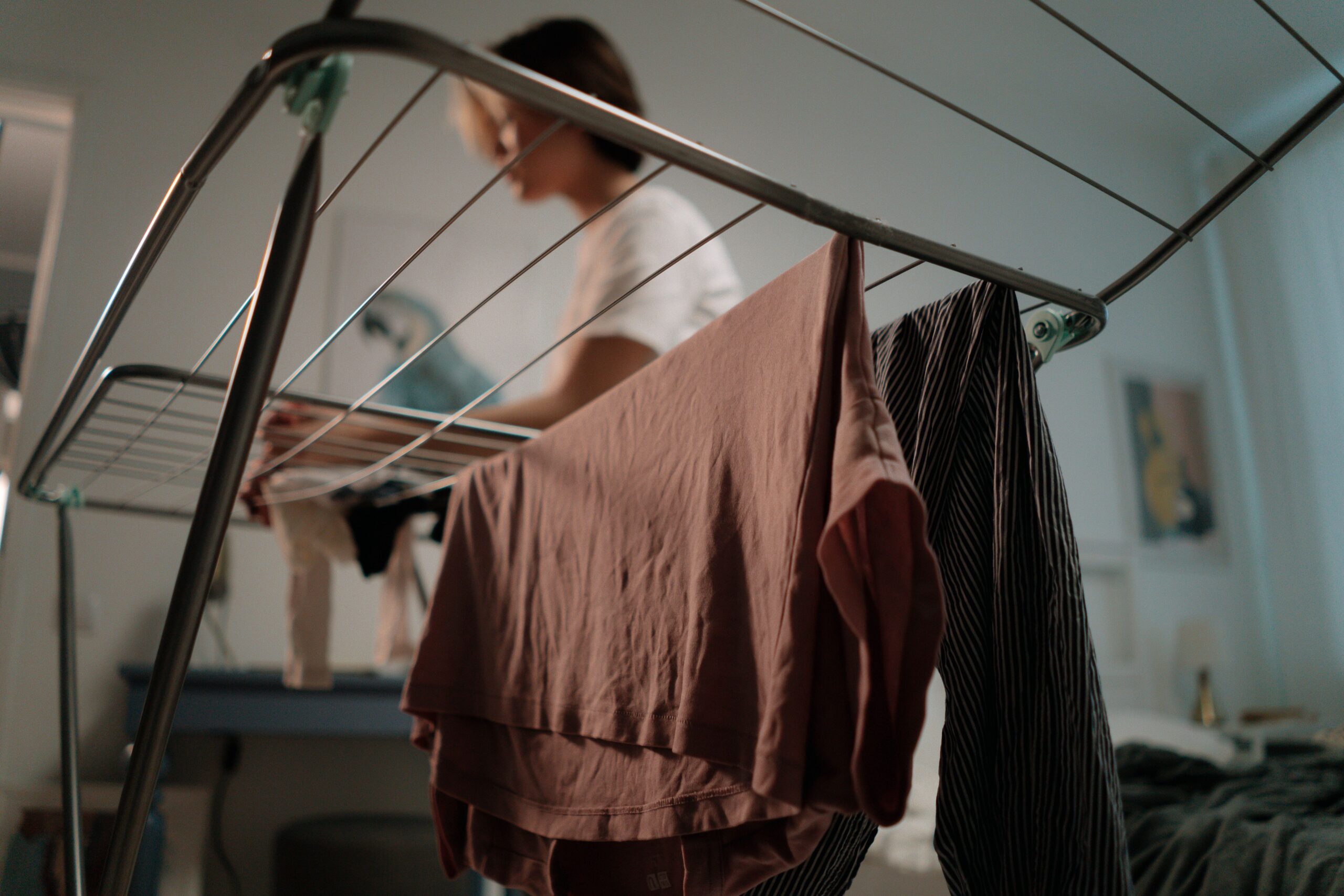
How to Dry Clothes Indoors Without Damp, Mould or a £1-a-Load Dryer Bill
It is the great British winter standoff: the washing line is rained off until March, the tumble dryer costs a small fortune to run, and the airer in the corner is quietly turning your spare room into a swamp. Clothes take two days to dry, the windows stream by morning, and somewhere behind the wardrobe, the mould is throwing a party.
Here is what most of us were never told: the problem is not the airer. It is the two litres of water hiding in every load, and where that water ends up. This guide compares every indoor drying method honestly — real running costs at today’s prices, drying times, and what each one does with the moisture — then gives you the step-by-step routine that dries clothes fast and keeps the damp out of your walls.
At a Glance
- The number to remember: 2 litres. That is roughly how much water one load of washing releases into your home’s air as it dries. It has to go somewhere out a window, into a dehumidifier tank, or into your walls.
- Cheapest fast method: a plain airer next to a dehumidifier on laundry mode — about 16p–55p per load, and the water ends up in a tank, not on your windows.
- The false economy: a heated airer is cheap to run (around 32p–60p per load) but it pushes moisture into the air faster — used in a sealed room, it makes the damp problem worse, not better.
- The habit to break: draping clothes over radiators. It blocks your heating, spikes the humidity, and costs you money twice.
- The winning routine: extra spin → hang with gaps → smallest warm room, door shut → ventilate or dehumidify → done in hours, not days.
The Real Problem: Two Litres of Water With Nowhere to Go
Hang a load of washing indoors and every drop of water in it evaporates into your rooms. For an average family load, that is around 2 litres — the same as emptying a big fizzy-drinks bottle into the air, slowly, all over your house.
Warm air carries that water invisibly until it finds a cold surface: a window pane, an outside wall, the corner behind a wardrobe. There it condenses back into liquid, and repeated day after day, it becomes the black mould that official UK housing data links to a problem now reported by 7.7 million households.
So the question is never really “how do I dry clothes indoors?” It is: which method dries them fast, cheaply, AND takes the water back out of the air? Judged on that, the five common methods are not equal at all.
The 5 Indoor Drying Methods, Honestly Compared
Costs below use the current Ofgem price cap electricity rate for October–December 2026: 26.32p per kWh.
| Method | Cost per load | Typical drying time | What happens to the water |
|---|---|---|---|
| Plain airer + open window/extractor | ~0p | 12–36 hours | Escapes outside — but slowly, and your heat escapes with it |
| Heated airer (230–300W) | ~32p–63p (4–8 hrs) | 4–10 hours | Released into the room faster — needs ventilation or a dehumidifier alongside |
| Airer + dehumidifier (laundry mode) | ~16p–55p | 4–8 hours | Collected in the tank — the only no-dryer method that removes it |
| Heat pump tumble dryer | ~26p–39p | 1–2 hours | Collected in the tank/drain |
| Condenser/vented tumble dryer | ~66p–£1.18 | 1–1.5 hours | Collected/vented — but the priciest run of all |
Three things jump out of that table.
i. First, the classic condenser tumble dryer — still the most common type in UK homes — can cost over three times more per load than a dehumidifier setup; one widely cited comparison puts a condenser dryer at ~£1.18 a load against ~32p for a heated airer run for four hours, a gap worth roughly £226 a year at five loads a week.
ii. Second, speed is not the same as dryness: the heated airer dries the clothes but floods the room.
iii. Third, the dehumidifier pairing is the quiet winner — near the cheapest per load, respectable speed, and the moisture leaves in a tank you empty down the sink.
💡 The rule that decides everything: drying the clothes is only half the job. If the method doesn’t also remove the water from the air, you haven’t solved the problem — you’ve just moved it onto your windows.
Choosing a Dehumidifier for Laundry: What Actually Matters
If you buy one thing from this guide, this is it — but buy the right one. Dehumidifier marketing is full of numbers that do not matter. These do:
- Compressor or desiccant? Compressor models (the common, cheaper type) work best in heated rooms above roughly 15°C. Desiccant models cost more to run per hour but keep working in cold rooms, spare rooms and garages where compressors give up — and the air they blow out is slightly warm, which helps the drying.
- Extraction rating (litres per day). For a flat doing a few loads a week, a 10–12L model copes. For a family home drying most days, go 16–20L. Bigger is not automatically better — an oversized unit in a tiny flat is just louder and pricier.
- A laundry mode. Better models have one: it runs the fan hard and aims for a lower target humidity for several hours, then eases off. It is the difference between “dehumidifier in the room” and “dehumidifier drying your clothes”.
- Tank size or a drain hose. A load adds about 2 litres to the air; a tank under 2.5 litres means mid-cycle emptying. A continuous-drain hose into a sink removes the chore entirely.
- Running cost. Most home units draw 130–350W — roughly 4p to 9p per hour at the current 26.32p/kWh price cap. Even five hours of drying rarely passes 50p.
- Price. Expect around £100–£180 for a good compact model and £150–£250 for a family-size one with laundry mode. Skip the tiny £30–£50 desktop units for laundry — they extract a teacup a day and will disappoint you within a week.
The No-Damp Drying Routine (Step by Step)
Whatever method you choose, this routine is what keeps the damp out:
- Spin it twice. Before anything comes out of the machine, run an extra spin cycle. A fast final spin (1200–1400 rpm) can leave clothes dramatically drier than a gentle one — water removed by the drum is water that never enters your air.
- Shake everything out. Unball socks, unroll sleeves, straighten seams. Crumpled clothes dry in patches and smell musty where they stayed damp.
- Hang with air gaps. This is where most people lose the race: an overloaded airer where every item touches its neighbour can take twice as long to dry. Thick items (jeans, hoodies, towels) get the outer rails and the most space; small items go in the middle.
- Choose the smallest warm room. Warm air dries faster, and a small room is cheaper to keep warm and easier to dehumidify or ventilate. The box room beats the big living room every time.
- Shut the door. Keep the moist air in that one room instead of letting it drift to colder bedrooms and condense there.
- Give the water an exit. Open that room’s window a crack (or better, give the room a proper house burp when the load is nearly dry), run the bathroom extractor if the load is in there, or switch the dehumidifier to laundry mode and point it at the airer.
- Use the tent trick with a heated airer. Drape a large sheet or duvet cover over the loaded airer, down to the floor. It traps the rising heat in a warm microclimate, so the parts of each garment not touching the heated bars dry too — noticeably faster.
- Turn heavy items once. At the halfway point, flip jeans, jumpers and towels so the dampest folds get their turn in the airflow.
- Take clothes off promptly. Dry clothes left sitting on the airer in a humid room re-absorb moisture and pick up that sour smell. Fold or put away as soon as they feel dry.
How Long Should a Load Take? A Fabric-by-Fabric Guide
“Drying time” depends on the fabric more than the gadget. These are typical ranges in a normally heated room (18–21°C) with the routine above followed — expect a cold room to add hours, which is exactly why the room choice matters:
| Fabric / item | Plain airer | Heated airer | Airer + dehumidifier |
|---|---|---|---|
| Synthetics & sports kit | 3–6 hours | 1.5–3 hours | 2–4 hours |
| Cotton t-shirts & underwear | 8–14 hours | 3–5 hours | 4–7 hours |
| Shirts & blouses | 6–12 hours | 2.5–4 hours | 3–6 hours |
| Jumpers & knitwear | 12–24 hours | 5–8 hours | 6–10 hours |
| Jeans & heavy cotton | 18–30 hours | 6–10 hours | 8–14 hours |
| Towels & bedding | 16–28 hours | 5–9 hours | 6–12 hours |
Use these as a health check: if your cotton load on a plain airer is passing the 24-hour mark in a warm room, the method is not the problem — the routine is. Check the spin, the gaps and the room before you blame the airer or buy anything.
Renting a Small Flat? Your Best Set-Up
Small rented flats are where indoor drying is hardest — no spare room, no garden, and a deposit riding on those walls. This combination works in the tightest space:
- A slim ladder airer or over-door rack (£35–£45) instead of a wide winged airer — it leans or hangs, uses vertical space, and folds flat behind a door.
- Dry in the bathroom if it has an extractor fan. Fan on, door shut, window cracked if there is one. The room is built to get wet; your bedroom is not.
- A compact dehumidifier is a renter’s best friend — no installation, no drilling, and it protects both your deposit (no mould marks) and your clothes.
- Never dry in the room you sleep in if you can help it — you would be breathing that load’s worth of moisture all night.
- If the airer must live in the living room, put it near (not on) the radiator, and burp the room for 10 minutes when the load comes off.
What I’d Do in My Own Home
My honest pick, after all the numbers: a plain sturdy airer plus a dehumidifier with a laundry mode, in the smallest room, door shut. It is close to the cheapest way to dry a load, the water leaves the house in a tank instead of migrating into the walls, and the dehumidifier earns its keep the rest of the week fighting bathroom steam and window condensation.
A heated airer would be my second buy — brilliant for speed on bedding days — but only ever run with the dehumidifier or an open window beside it, never alone in a sealed room. And I would spend the £0 first: the double spin and the hanging gaps on their own cut drying time more than most gadgets do.
5 Indoor Drying Mistakes That Feed the Mould
- Drying clothes on radiators. The clothes block the radiator’s warm air from circulating, so your thermostat keeps the heating running longer — you pay more — while all that water is driven off in one fast burst straight into the room’s air. Worst method on both counts.
- Cramming the airer. Every garment touching its neighbour means no airflow, double the drying time, and sour smells in the folds. Two half-loads on the airer beat one stuffed one.
- Drying in the bedroom. A night spent breathing a load’s worth of evaporating water — in usually the coolest room in the house, where that moisture settles on the walls behind the bed and wardrobe.
- Sealing the room “to keep the heat in”. With no window, extractor or dehumidifier, the water has literally nowhere to go except the walls. Heat without an exit is a mould recipe.
- The two-day load. If clothes are still damp after 24 hours, something above has gone wrong. Leaving them to crawl to dryness over two days is exactly how the musty smell — and the spores — move in.
Conclusion
Indoor drying only causes damp when the water has nowhere to go. Give every load an exit — a dehumidifier tank, an extractor, or ten minutes of wide-open windows — and the whole winter problem mostly dissolves: clothes dry in hours for pennies, windows stay clear, and the mould never gets its invitation. The routine costs nothing to start (double spin, air gaps, right room, shut door), and the one gadget worth buying, a dehumidifier, pays for itself in saved dryer bills.
Frequently Asked Questions
Q1. Why do my clothes smell musty even after they’ve dried indoors?
That sour, fusty smell is bacteria that multiplied while the clothes stayed damp for too long — slow drying is almost always the cause, especially in thick seams, waistbands and towels. Fix the speed first (extra spin, air gaps, a dehumidifier in the room). For clothes that already smell, rewash with a cup of white vinegar in the drum or a laundry sanitiser, then dry them fast — the smell rarely survives a quick dry.
Q2. Is it safe to dry clothes indoors when there’s a baby in the house?
Yes, with one rule: not in the baby’s room. High humidity and any mould it encourages are what you are avoiding, and babies breathe the air in their room all night. Dry in the bathroom, box room or kitchen with the door shut and the moisture being extracted or collected, keep the nursery ventilated normally, and the laundry is no problem at all.
Q3. How do I dry big items like duvets and bedding indoors?
Wash them on a dry, bright day if you can, spin twice, then drape the duvet over the whole airer plus a door or bannister so both sides get air — never fold it over a rail in quarters, the middle layers will still be damp tomorrow. A heated airer underneath with the sheet-tent trick is made for bedding days, and a dehumidifier pointed at it cuts hours off. In a small flat, honestly, a launderette’s big drum twice a season for the winter duvet swap is money well spent.
Q4. I have asthma. Is indoor drying bad for me?
It deserves care. Damp air and mould spores are common asthma triggers, and studies have linked indoor laundry drying to higher spore counts in homes that already have a mould problem. The protection is the method, not abstinence: dry in one shut room with a dehumidifier collecting the water, keep your bedroom a no-drying zone, and if you can see mould anywhere in the home, treat that first — the laundry routine is prevention, not a cure.
Q5. Will a heated airer work in a cold room or a garage?
Poorly. Heated airers rely on the warm air around the clothes as much as the bars themselves, so in a cold garage the same load can take hours longer and cost noticeably more to dry. A cold room also invites the moisture to condense on its cold walls. If the garage is your only space, a dehumidifier rated for low temperatures (a desiccant model) beside a plain airer usually beats a heated airer out there.
Q6. How many loads a week can a small flat actually handle?
Think in water, not loads. Each load is about 2 litres; five loads a week is roughly 10 litres your flat must get rid of. With a dehumidifier or good ventilation handling one load at a time — fully dried before the next goes on — a small flat copes fine. Trouble starts when loads overlap: one drying while the next is already on, day after day, with no dry interval. If your windows are still wet at breakfast, your flat is telling you it is behind.
Q7. Can I dry clothes overnight while I sleep?
You can — a dehumidifier on a timer in a shut spare room is a sensible overnight set-up, and off-peak electricity tariffs can make those hours the cheapest of the day. Two cautions: never leave a heated airer running unattended overnight (treat it like any heater — on while you’re up, off when you’re not), and don’t dry overnight in your own bedroom, for the breathing-the-moisture reason above.