Home Insulation in the UK: Types, Costs, Benefits, and Installation Guide
British winters are long, damp and often colder than the houses we live in were designed for. Add heating bills that can swing from one year to the next, and it is easy to see why more people are looking at home insulation UK options than ever before.
A lot of the heat you pay for simply leaks out through the roof, walls, floors and gaps around doors and windows. Insulation slows that escape, so rooms stay warmer for longer and your heating has less work to do. The right choice, though, depends on how your home was built, what it already has, your budget and the support available. A 1930s semi with cavity walls needs a very different approach from a Victorian terrace with solid brick.
Below, you will find what each type of insulation does, what it typically costs, what you might realistically save, which grants are still open in 2026, and how to avoid the mistakes that cause problems later.
What Is Home Insulation?
Home insulation is any material or system that slows the movement of heat between the inside of your home and the outside. In winter, it helps keep warmth in. In summer, a well-insulated roof can also reduce unwanted heat gain, so upstairs rooms are less likely to overheat.
Insulation is often confused with other parts of a warm home, so it helps to separate them:
- Insulation reduces heat transfer through roofs, walls and floors.
- Draught-proofing seals unwanted gaps where cold air leaks in.
- Ventilation supplies fresh air and removes moisture. Some of it is deliberate and must stay open.
- Heating systems produce the heat in the first place.
Insulation does not replace ventilation or a good heating system. A well-insulated house still needs controlled airflow to keep condensation and mould in check, and it still needs a boiler or heat pump that suits its size.
Why Is Home Insulation Important in the UK?
The UK has some of the older housing stock in Europe, and many homes were built long before modern energy standards. Insulating them brings several benefits:
- Less heat loss. Energy Saving Trust research suggests that around a quarter of the heat in an uninsulated home escapes through the roof.
- Better comfort. Warmer walls and floors mean fewer cold spots and less of that “cold even with the heating on” feeling.
- Potentially lower heating bills. You need less energy to reach the same temperature.
- A better EPC rating. Insulation is one of the main improvements that can raise your Energy Performance Certificate score.
- Less condensation, when done properly. Warmer internal surfaces are less likely to attract moisture, but only if ventilation is handled correctly.
- Lower carbon emissions. Using less energy supports the UK’s wider energy-efficiency and carbon-reduction goals.
Savings are never identical from one house to the next. They depend on the property’s condition, what insulation it already has, the heating system, energy prices, how warm you keep your home and the quality of the installation.
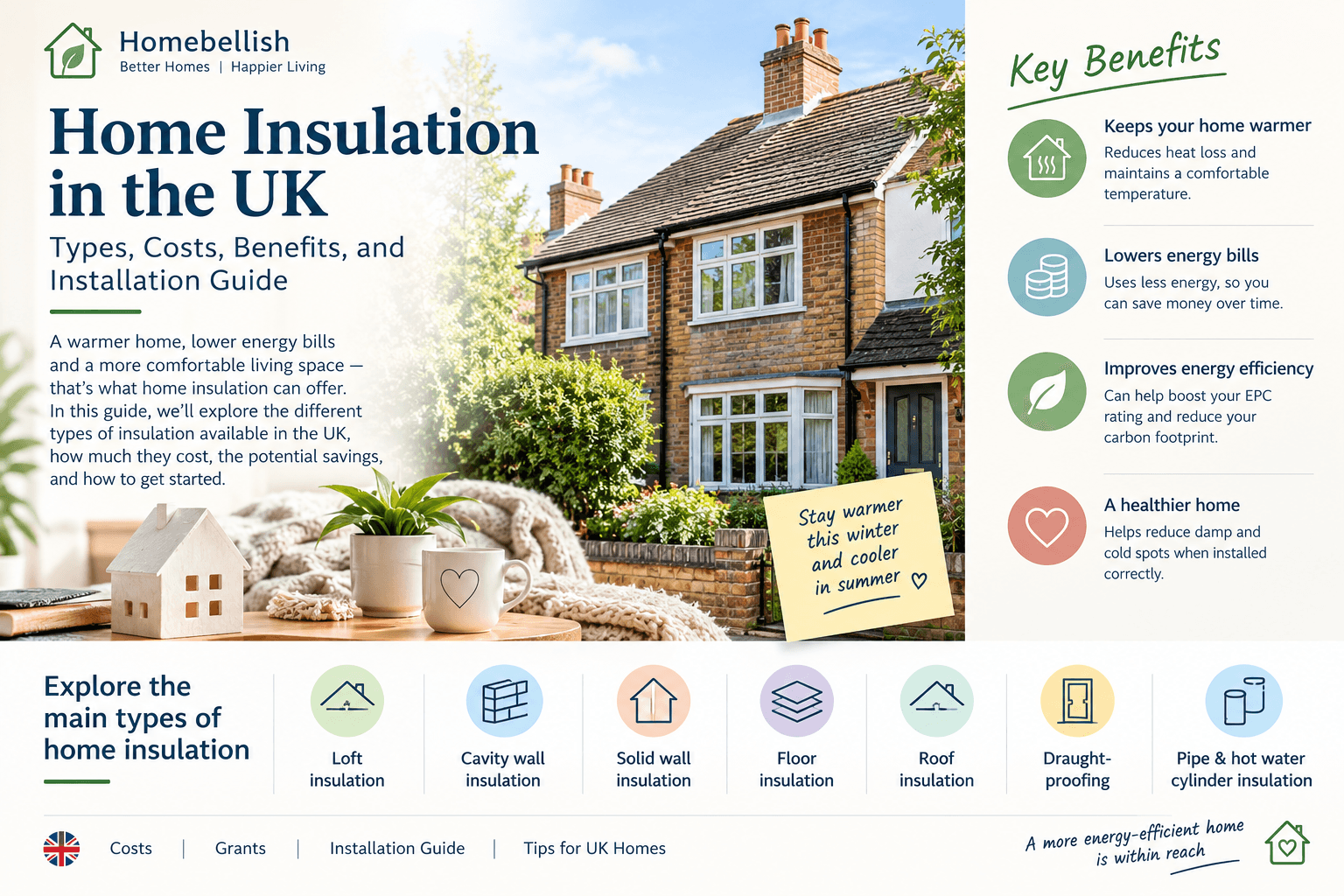
Different Types of Home Insulation in the UK
Loft Insulation
Loft insulation is usually the simplest and most cost-effective place to start. In a typical “cold loft”, insulation is laid between and over the ceiling joists, so heat stays in the rooms below and the loft space stays cold.
Common materials include mineral wool rolls, loose-fill (such as cellulose or mineral wool), and rigid boards. Current Energy Saving Trust guidance is for a depth of around 270mm of mineral wool, and many UK homes still have less than that.
A few practical points matter:
- Loft access. A narrow hatch or a loft full of belongings makes the job harder and may add to the cost.
- Ventilation. Do not push insulation into the eaves so tightly that you block airflow. Roof ventilation needs to stay clear.
- Water tanks and pipes. Insulate the tank and pipes themselves, but leave the area directly under the tank uncovered so heat from the room below keeps it from freezing.
- Electrics. Keep insulation away from hot or poorly protected cables and recessed lighting unless the fittings are rated for contact.
- Storage. If you want to use the loft for storage, raised boards over the joists keep the insulation at full depth.
Some homeowners can do accessible loft insulation themselves. A professional is wise if the loft is cramped, the wiring looks old, or you are unsure about damp or roof condition.
Cavity Wall Insulation
Most homes built from the 1920s onwards have cavity walls: two layers of masonry with a gap between them. GOV.UK’s clean energy campaign notes that cavity wall insulation can typically be fitted in homes built after the 1920s. Installers drill small holes in the outer wall and blow insulation into the gap, then fill the holes.
Not every cavity wall is suitable. A professional survey should check the condition of the walls, the width of the cavity, any existing fill and how exposed the property is. In very exposed locations, or where walls already suffer from rain penetration, insulation can carry a moisture risk. That is why a qualified surveyor and a registered installer with a proper guarantee are important here.
Solid Wall Insulation
Older homes, including many Victorian and Edwardian houses, have solid walls with no cavity. They tend to lose more heat through the walls than cavity-wall homes, but they also cost much more to insulate. There are two routes.
Internal wall insulation (IWI) adds insulation boards or a insulated lining to the inside face of external walls.
- Advantages: usually cheaper than external work, can be done room by room, and does not change the outside appearance.
- Disadvantages: takes up some floor space, causes disruption indoors, and radiators, sockets and skirting boards may need moving.
External wall insulation (EWI) fixes insulation to the outside of the house and covers it with a render or cladding.
- Advantages: little loss of room space, less disruption indoors, and it can improve airtightness and appearance.
- Disadvantages: higher cost, a changed look to the house, and possible planning or conservation-area restrictions. Terraces and semis also need careful detailing where neighbouring properties meet.
Before either option, a surveyor should assess damp, ventilation, window reveals, roof edges and other junctions. Poorly detailed solid wall insulation can create the very moisture problems you want to avoid.
Floor Insulation
Ground floors can lose heat through gaps and cold air under the house. Two main situations come up:
- Suspended timber floors, common in older homes, can be insulated from below (if there is a crawl space) or from above by lifting floorboards. Insulation is fitted between the joists.
- Solid floors can be insulated, but usually only when the floor is being replaced or raised, so it tends to be part of a larger renovation.
Check for pipes, wiring and signs of damp before starting, and make sure there is adequate ventilation under a suspended floor. Blocking air bricks can lead to rot. Floor insulation usually saves less than loft or wall work, but it can make a noticeable difference to comfort and draughts.
Roof Insulation
There are two main approaches:
- Cold loft: insulation at ceiling level (see loft insulation above).
- Warm roof or rafter-level insulation: insulation follows the slope of the roof, creating a warmer loft space. This is common in loft conversions or when the roof is being re-covered.
Rafter-level insulation needs careful design to control moisture and ventilation, and the wrong system in the wrong roof can trap damp. This is generally work for a qualified roofer or builder who understands the whole roof build-up.
Draught-Proofing
Draught-proofing seals gaps around doors, windows, floorboards, loft hatches and letterboxes. It is inexpensive, can often be done by a confident DIYer, and works well alongside insulation.
One rule matters: do not block intentional ventilation, such as air bricks, trickle vents and extractor fans, or the air supply needed for open fires, flues or some gas appliances. Homes need controlled ventilation to stay healthy.
Pipe and Hot Water Cylinder Insulation
Insulating accessible hot water pipes and cylinders keeps heat where you need it and can cut wasted energy. For a cylinder, a properly fitted jacket or factory-fitted foam is better than leaving it bare. What is suitable depends on your system and what is already fitted, so check before adding anything.
Which Type of Insulation Is Best for Your Home?
There is no single best insulation for every UK property. The right mix depends on how your home is built and what it already has.
| Insulation type | Suitable property or area | Main benefit | Important consideration |
|---|---|---|---|
| Loft | Homes with an accessible loft | Often the best value for money | Keep roof ventilation clear and protect tanks and wiring |
| Cavity wall | Many homes built after the 1920s with unfilled cavities | Fast, low-disruption install | Needs a survey; exposure to driving rain matters |
| Solid wall (internal or external) | Older homes without a cavity | Tackles a major source of heat loss | High cost; needs moisture and detailing checks |
| Floor | Ground floors, especially suspended timber | Warmer floors, fewer draughts | Keep under-floor ventilation open |
| Roof (rafter level) | Loft conversions and re-roofing projects | Creates a warm, usable roof space | Needs careful moisture and ventilation design |
| Draught-proofing | Almost any home | Low cost and quick | Never block intentional ventilation |
When choosing, weigh up:
- Property age and wall construction. Cavity or solid, brick, stone or timber frame.
- Exposure to wind-driven rain. This affects cavity wall suitability.
- Existing insulation. Topping up may be better value than starting afresh.
- Budget. Start with the best value per pound spent, often the loft and draughts.
- Renovation plans. If you are re-roofing, replastering or replacing floors, that may be the cheapest time to add insulation.
For most homes, a sensible order is: draught-proofing, loft, cavity walls, then floors and solid walls. Always check what applies to your own property.
Home Insulation Costs in the UK
UK home insulation costs vary by region, property size, access, materials, preparatory work and installer. The figures below are indicative installed costs for a typical three-bedroom semi-detached house, based on Energy Saving Trust estimates as reported by Rightmove, Which? and GreenMatch. They are not quotations.
| Insulation type | Indicative cost range | What affects the final price |
|---|---|---|
| Loft insulation (uninsulated to 270mm) | Around £900 to £1,000 for a semi-detached house | Loft size, access, material, clearing and boarding |
| Cavity wall insulation | Around £2,700 | Wall area, cavity width, material, access |
| Internal solid wall insulation | Around £7,500 to £8,500 | Wall area, finishes, moving radiators and sockets |
| External solid wall insulation | Around £12,000 or more | Scaffolding, finish, building size, planning |
| Suspended floor insulation | Around £1,600 to £2,900 (some estimates run higher) | Floor area, access, ventilation, pipework |
| Roof insulation (rafter level) | Varies widely; get written quotes | Roof type, system, whether it is part of re-roofing |
| Draught-proofing | Around £200 to £225 professionally; DIY costs much less | Number of windows and doors, DIY or professional |
| Pipes and hot water cylinder jacket | Roughly £15 to £20 for DIY materials | Size and type of cylinder and pipework |
A few notes on how to read these numbers:
- They are estimates for installed jobs on a typical semi, not materials alone.
- Costs for detached houses, large homes and awkward access are higher; flats and small terraces are often lower.
- Prices are rising and falling with materials and labour, so treat any figure as a starting point.
- Reports in 2026 indicate that most energy-saving materials are currently zero-rated for VAT until 31 March 2027. Check current rules on GOV.UK before relying on this.
Always get several written quotations and ask exactly what is included.
How Much Can You Save with Home Insulation?
Insulation reduces the heat that escapes, so your heating system needs to work less to keep the house at the same temperature. But savings are never a guarantee. They depend on:
- How well insulated the home is to begin with.
- Your heating fuel and energy tariff.
- The temperature you keep the house at.
- The size and type of the property.
- The quality of the installation.
Energy Saving Trust estimates, assuming a gas-heated three-bedroom semi, give a rough idea. Figures differ between sources because they are calculated using different energy price caps:
- Loft insulation (uninsulated to 270mm): roughly £215 to £285 a year
- Cavity wall insulation: around £300 a year for a semi-detached house, with a wider range of about £110 to £380 across house types
- Solid wall insulation: up to about £500 a year
- Floor insulation: around £80 a year
- Draught-proofing: a smaller saving, in the tens of pounds a year
Loft and cavity wall insulation are often reported to pay for themselves within a few years, and GOV.UK’s clean energy campaign says they typically last around 40 years. Solid wall insulation takes far longer to recoup its cost on energy savings alone.
It is also worth separating three different outcomes:
- Energy savings: lower consumption and bills.
- Comfort: warmer rooms and fewer draughts, which you may enjoy by turning the heating down rather than saving money.
- EPC rating: a measure of efficiency that may or may not move by a whole band.
No fixed percentage saving or payback period can be promised.
Are There Home Insulation Grants in the UK?
Financial support may be available, but it depends on where you live, your household circumstances, the property and the date. Schemes have changed considerably in 2026, so check current rules before applying.
- Great British Insulation Scheme (GBIS): this closed to new applications and ended on 31 March 2026. If a website still promotes it, treat it with caution.
- ECO4 (England, Scotland and Wales): reports indicate it was extended and runs until 31 December 2026, with no successor supplier scheme planned. With the end date approaching, installations need to be completed by then, so do not leave it late.
- Warm Homes: Local Grant (England): delivered through local councils for eligible lower-income households in privately owned homes with lower EPC ratings. It is part of the wider Warm Homes Plan.
- Scotland: support is available through Home Energy Scotland.
- Wales: the Welsh Government runs its own programmes, including Nest. Check its website for current criteria.
- Northern Ireland: GOV.UK’s clean energy campaign states that financial support towards loft and cavity wall insulation may be available.
- Local councils: many run or signpost local energy-efficiency schemes.
Not every homeowner qualifies. Support is generally aimed at lower-income households, those receiving certain benefits, or homes with poorer energy ratings. Start at GOV.UK, your devolved government’s site or your local council to check current eligibility and use only authorised scheme routes.
How to Insulate a House: Step-by-Step Guide
- Assess your current insulation and identify where heat is being lost.
- Check the property’s age and wall construction. Cavity or solid will determine your options.
- Review your EPC and any existing energy assessment for recommendations.
- Look for damp, leaks, condensation or roof damage. Fix these first.
- Decide which improvements make sense, starting with the best value measures.
- Check current grants and other financial support.
- Get several written quotations from qualified, accredited installers.
- Confirm the details: materials, scope of work, guarantees, ventilation arrangements and any building regulations compliance.
- Arrange installation and check the finished work.
- Keep your paperwork: invoices, product details, warranties and certificates.
A professional survey is especially important for cavity walls, solid walls, older properties and anywhere with a history of damp. Major insulation work should not start until moisture and ventilation problems are understood, because insulation can hide or worsen them.
Can You Install Home Insulation Yourself?
Some smaller jobs suit a competent DIYer:
- Most draught-proofing tasks.
- Insulating accessible pipes and a hot water cylinder.
- Laying mineral wool in an easily accessible, dry, well-lit loft with sound wiring.
Other work should go to trained professionals:
- Cavity wall insulation.
- Solid wall systems.
- Complex roof insulation.
- Anything involving electrical systems or structural changes.
If you do DIY, keep safety in mind:
- Electrical cables and recessed lighting: keep insulation away from hot fittings and avoid covering poorly protected wiring.
- Loft access: use a proper ladder and lay boards to walk on. Step only on joists or boards.
- Respiratory protection: wear a dust mask or respirator, gloves, eye protection and long sleeves.
- Working at height: never lean over or step between joists.
- Older materials: if you suspect asbestos or other old building materials, do not disturb them. Get a specialist to check first.
Common Home Insulation Mistakes to Avoid
- Choosing insulation without checking wall construction.
- Ignoring damp, leaks or damaged roof coverings.
- Blocking ventilation openings such as air bricks, eaves vents and trickle vents.
- Failing to address moisture and condensation risks.
- Putting insulation around unsuitable electrical equipment.
- Using materials that do not suit the building.
- Focusing on one measure and ignoring windows, doors and other heat loss.
- Picking a contractor on the cheapest quote alone.
- Assuming insulation guarantees a specific cut in energy bills.
- Skipping checks on warranties, certification and building regulations.
Home Insulation for Older UK Houses
Insulation for old houses UK-wide needs particular care. Victorian, Edwardian, stone-built and other traditional properties usually have solid walls, suspended timber floors and older roofs. They were designed to manage moisture differently from modern buildings: walls absorb and release moisture, and gaps provide natural ventilation.
That matters because the wrong materials can trap moisture and cause damp, rot or mould. Many traditional buildings suit breathable materials and a more careful approach than a modern house would need.
Some sensible principles:
- Do not assume every old house should use the same insulation or method.
- Fix leaks, failing pointing and damp problems before insulating.
- Start with the lower-risk measures: loft insulation, draught-proofing and pipework.
- For walls and floors, get advice from a surveyor or specialist who understands traditional construction.
- Listed buildings and conservation areas have extra rules, so check with your local council.
Does Home Insulation Improve an EPC Rating?
It can. An Energy Performance Certificate rates a home’s energy efficiency from A to G, and measures such as loft insulation, cavity wall insulation and solid wall insulation can all contribute to better energy performance. Your EPC also lists recommended improvements, which is a useful starting point.
The actual result depends on the property’s overall characteristics, such as its heating system, windows and existing insulation, and on how the assessment is carried out. A single measure may not move the rating by a full band, and no particular improvement can be guaranteed. Landlords should also keep an eye on current minimum energy efficiency rules, as the government has said it intends to raise standards for rented homes.
Frequently Asked Questions
Q1. What is the cheapest way to insulate a house in the UK?
Draught-proofing and insulating pipes and hot water cylinders are usually the cheapest. After that, loft insulation tends to give the best return for the money.
Q2. What type of insulation is best for a UK home?
There is no single best type. Loft insulation suits most homes, cavity wall insulation suits many homes built after the 1920s, and solid walls need a different approach. A survey will show what suits your property.
Q3. How much does home insulation cost in the UK?
It ranges from tens of pounds for DIY draught-proofing to around £12,000 or more for external solid wall insulation on a typical semi. See the cost table above, and always get written quotes.
Q4. Can I get free home insulation in the UK?
Possibly, if you meet the eligibility rules. In 2026, ECO4 runs until 31 December and councils in England deliver the Warm Homes: Local Grant. Scotland, Wales and Northern Ireland have their own routes. Not everyone qualifies.
Q5. Is loft insulation worth it?
For most homes with poor or no loft insulation, yes. It is usually the best value measure and often pays back within a few years, although the exact saving depends on your home and energy prices.
Q6. Can cavity wall insulation cause damp?
It can in unsuitable properties, such as very exposed homes or walls already affected by rain penetration. A proper survey and a registered installer reduce the risk.
Q7. How do I know if my house has cavity walls?
As a rule of thumb, homes built after the 1920s often have cavity walls, and older homes usually have solid walls. Brick pattern and wall thickness are clues, but a surveyor or installer can confirm.
Q8. Is internal or external wall insulation better?
Neither is better in every case. Internal insulation is usually cheaper and does not change the exterior but reduces room space. External insulation costs more, keeps rooms intact and changes the home’s appearance.
Q9. Can I insulate an old house?
Yes, but the method must suit the building. Start with the lower-risk measures and get specialist advice before adding wall or floor insulation.
Q10. Does home insulation improve an EPC rating?
It can contribute to a better rating, but the result depends on the whole property and cannot be guaranteed.
Q11. Can I install loft insulation myself?
Often yes, if the loft is accessible, dry and has safe wiring, and you follow safety precautions. Use a professional if the loft is cramped or you are unsure.
HQ12. ow long does home insulation last?
GOV.UK’s clean energy campaign says cavity wall and loft insulation typically last around 40 years, subject to condition and installation quality.
Conclusion
Good home insulation UK-wide comes down to a few simple steps: understand how your home is built, find where heat is escaping, and choose measures that suit the property rather than copying what worked next door. Start with the best-value jobs, check the current grants before you spend, and bring in qualified professionals for walls, roofs and anything involving moisture.
Well-planned insulation can make your home warmer, more comfortable and more efficient for decades. For more practical advice, explore the other home improvement guides on Homebellish.