Radiator Cold at the Bottom? How to Bleed a Radiator and Fix Cold Spots
You put the heating on an hour ago. The top of the radiator is lovely and hot. However, the bottom is stone cold, and the room never quite warms up. If you have a radiator cold at the bottom like this, you are not imagining it, and your boiler is probably fine. Something inside that one radiator is blocking the hot water. In fact, the cause is almost always one of three simple things.
The good news is that the first fixes cost almost nothing. This guide also starts with a one-minute test that tells you exactly what is wrong. It then walks you through each fix in order, from a £1 radiator key to the jobs that need a professional, with real UK costs at every step.
At a Glance – First test for a radiator cold at the bottom: run a hand over it. Cold at the top means trapped air. Cold at the bottom means sludge. – Cheapest fix: bleeding with a radiator key, about £1, takes 5 minutes per radiator. – Biggest mistake: bleeding a radiator for a sludge problem. Bleeding moves air, not sludge. As a result, the bottom stays cold. – One number to remember: boiler pressure should sit at 1 to 1.5 bar when the system is cold. – Renter-friendly: bleeding and topping up pressure are also fine to do yourself. Flushing is your landlord’s job.
The 1-Minute Touch Test: What Your Radiator Is Telling You
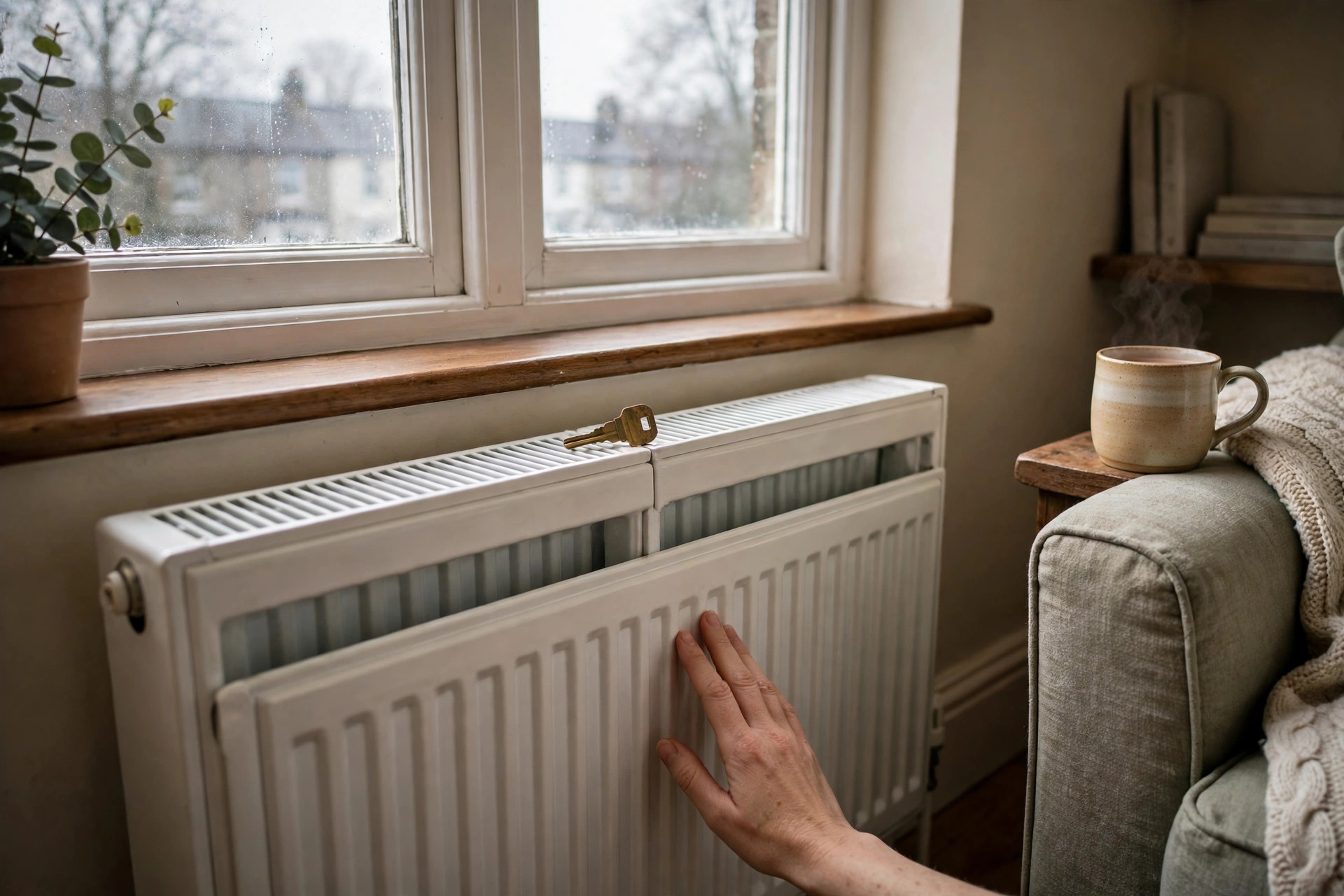
First, turn the heating on and let it run for about 20 minutes. Next, run your hand slowly over one radiator, from top to bottom. Do the same on the others. The pattern of heat tells you the cause, so you never have to guess.
Cold at the top, warm at the bottom
This is trapped air. Air rises inside the radiator and sits at the top. As a result, the hot water cannot fill the whole panel, and the top stays cool. You might also hear gurgling sounds when the heating starts up. Indeed, bleeding fixes this, and it is the easiest job in this guide.
Cold at the bottom, warm at the top
This is the pattern in our title, and it usually means sludge. Tiny bits of rust and dirt also build up inside the system over the years. They sink and settle in the bottom of the radiator, where the water moves slowest. The hot water instead flows over the top of this layer and never heats the bottom half. Bleeding will not fix this one, because you cannot bleed out mud.
Cold all over, while the others are hot
One radiator that stays cold all over, while the rest of the house is warm, points to a stuck valve or a system that needs balancing. In other words, the hot water is not reaching that radiator at all. The valve pin fix and the balancing fix below both cover this.
Every radiator in the house is cold
Finally, if every radiator is cold, the problem is not the radiators. It is more likely the boiler, the pump or the heating controls. Check the boiler display and the timer settings first. If the boiler shows an error code you do not understand, skip to the safety section at the end of this guide.
Fix 1: How to Bleed a Radiator, Step by Step
Do this fix when the touch test shows a cold top. It lets the trapped air out. As a result, hot water can fill the whole radiator again. The Energy Saving Trust, for instance, lists bleeding your radiators among its simple steps for helping heating run well, because a radiator full of air heats a room poorly.
You need three things: a radiator key (about £1 from any DIY shop), an old cloth, and a small cup or bowl.
- Turn the heating off and let the radiators cool. This matters, because the water inside can be hot enough to scald. Wait until the radiator feels cool to touch.
- Find the bleed valve. It is a small square pin inside a round fitting, at one of the top corners of the radiator.
- Put the cloth under the valve and hold the cup ready. A little water will escape at the end.
- Fit the key and turn it anticlockwise, about a quarter turn. You should hear a hiss. That hiss is the trapped air leaving.
- Next, wait for the hiss to stop. As soon as water starts to dribble out in a steady flow, turn the key clockwise to close the valve. Firm is enough. Never force it.
- Afterwards, repeat on the other radiators that were cold at the top. Work from the ground floor upwards, because air rises through the system.
Do not skip the pressure check
Bleeding lets out a little water. Consequently, the pressure gauge on a combi or system boiler often drops. Check the gauge once you have finished bleeding. It should read 1 to 1.5 bar when cold. If it sits below 1 bar, top it up using the filling loop, following your boiler manual.
Finally, turn the heating back on. In short, within about 20 minutes the whole radiator should feel hot, top to bottom.
Fix 2: Radiator Cold at the Bottom? It Is Probably Sludge
If your radiator is cold at the bottom even after bleeding, the cause is almost always sludge. Sludge is the black, muddy mix of rust and dirt that settles inside older heating systems. It sits in the bottom of the radiator. As a result, it blocks the flow of hot water. In fact, there is a simple clue you can check yourself.
When you bleed that radiator, watch the colour of the water that dribbles out. Clear water is a good sign. Dark brown or black water means sludge is building up. You have three options here, from cheapest to most thorough.
Option 1: Flush one radiator in the garden
If only one radiator is cold at the bottom, you can flush that one radiator yourself. It is a messy job. However, it costs nothing but time. Turn the heating off and let everything cool. Next, close both valves at the bottom of the radiator. Place a tray and old towels under one valve, loosen the nut slowly, and drain the water into the tray.
Then undo the second valve, lift the radiator off its brackets, and carry it outside. It is heavier than it looks, because of the black water inside, so get help. Fix a garden hose to one end and flush clean water through until it runs clear from the other end. After that, hang the radiator back up, open both valves, and bleed it.
Option 2: Add a chemical cleaner
For light sludge in a few radiators, a heating engineer can add a strong cleaning chemical to the system. The chemical runs through the radiators for a short time and loosens the sludge, and then the system is drained and refilled with clean water and a protector called inhibitor.
This costs less than a powerflush. In addition, it suits smaller build-ups. Some confident homeowners buy the cleaner themselves for about £15 to £25. However, an engineer will dose it correctly and refill the system safely.
Option 3: Book a powerflush
A powerflush is the deep clean. An engineer connects a powerful pump to your system and pushes water and cleaning chemicals through every radiator and pipe at high speed. It shifts sludge that nothing else will move, in particular the heavy layer sitting in radiator bottoms.
For an average UK home, expect to pay roughly £300 to £600, depending on the number of radiators. Afterwards, ask for a magnetic filter on the pipe that returns to the boiler. The filter catches loose bits of rust before they can settle again, and fitting one typically adds about £100 to £150.
However, one warning matters here. On very old pipework, a powerflush can sometimes find weak joints that the sludge was quietly sealing. A good engineer will check the system first and tell you honestly if a gentler clean is safer.
Fix 3: One Radiator Stone Cold? Check the Valve Pin
Sometimes one radiator stays cold because its valve has stuck shut. This often happens to a radiator that was turned off all summer, for example in a spare room. The valve in question is the thermostatic radiator valve, the one with numbers on it that you turn up and down.
First, turn the valve to its highest number and wait 20 minutes with the heating on. If the radiator stays cold, the pin under the valve head may be stuck down. Turn the heating off and let things cool. Next, unscrew the valve head by hand. Indeed, you do not need tools for this part. Underneath, you will see a small metal pin.
It should move up and down when you press it gently. If it is stuck down, press it a few times with the flat end of a spoon handle until it springs freely. Never hit it hard, and never pull it out. Finally, screw the head back on, turn the heating on, and check again. In short, this fix is free, and it takes about 10 minutes.
Fix 4: Balance the Radiators So Every Room Gets Heat
Balancing sounds technical, but the idea is simple. Hot water is lazy. It rushes into the radiators nearest the boiler and only trickles into the far ones. As a result, the living room roasts while the back bedroom never warms up. Balancing means slowing the near radiators down a little, so every radiator gets its fair share.
You adjust the small valve at the opposite end of the radiator from the thermostatic valve. It is called the lockshield valve, and it also often hides under a plain plastic cap. Here is the simple version of the job.
- Turn the heating off and let the radiators cool. Then pull the cap off each lockshield valve.
- Open every lockshield fully by turning it anticlockwise. Also open every thermostatic valve fully.
- Turn the heating on. Next, note which radiators heat up first. Those are the greedy ones.
- Turn the heating off again. On the radiator that heated first, close its lockshield fully, then open it again by just a quarter turn.
- On the second-fastest radiator, open the lockshield half a turn. Give each slower radiator a little more than the one before it. Finally, leave the slowest radiator’s lockshield fully open.
- Afterwards, turn the heating back on and give it a full hour. Every radiator should now heat up at roughly the same speed and feel evenly hot.
Meanwhile, remember that balancing only works on a clean, air-free system. Bleed the radiators first, and leave sludge problems to the fixes above.
What Each Fix Costs in the UK
Costs vary by region and by the size of your home. However, these are the typical ranges you will see. In particular, use them to spot a fair quote and to plan your own order of attack.
| Fix | Budget (DIY) | Mid | Professional |
|---|---|---|---|
| Bleeding a radiator | Radiator key, about £1 | Key plus cloths and a bowl, under £5 | Rarely needed; an engineer visit starts around £60 to £90 |
| Fixing a stuck valve pin | Free, about 10 minutes | New valve head, about £10 to £20 | Engineer to replace the valve, about £80 to £150 |
| Chemical clean for sludge | Cleaner from a DIY shop, about £15 to £25 | Engineer chemical flush, about £150 to £350 | Chemical flush plus inhibitor and a magnetic filter, about £250 to £450 |
| Powerflush for heavy sludge | Not a DIY job | Smaller homes, about £300 to £400 | Larger homes, about £450 to £600 |
| Balancing the system | Free, with time and patience | Lockshield key and a simple guide, under £10 | Engineer balancing visit, about £80 to £150 |
In short, work up the table, not down it. Most cold radiators give up at the £1 stage. Once the heat is flowing again, keeping it inside the house matters too, so our UK insulation guide is worth a read next.
Renting? What You Can Do Yourself
Renter-friendly — read this before you pay for anything Bleeding your radiators is safe to do yourself in a rental, and topping up the boiler pressure with the filling loop is normally fine too, as long as you follow the boiler manual. A stuck valve pin is also a gentle, no-tools fix. However, do not pay for a chemical flush or a powerflush yourself.
The heating system belongs to your landlord, and keeping it in good working order is the landlord’s job. Instead, email your landlord or letting agent, describe the touch test result (for example, “hot at the top, cold at the bottom on two radiators”), and ask them to send an engineer. Keep that email. It is, in other words, proof that you reported the problem.
What I’d Do in My Own Home
If this were my house, I would spend one Saturday morning in October on it, every year. First, I would bleed every radiator, starting downstairs. Next, I would check the boiler pressure and top it up to about 1.2 bar. Meanwhile, I would do the touch test on every radiator and write down any that stayed cold at the bottom.
Indeed, one cold bottom on an old system would not scare me into a £500 powerflush. Instead, I would flush that single radiator in the garden myself. However, if two or three radiators had cold bottoms and the bleed water came out black, I would book the powerflush and the magnetic filter together. That combination stops the problem coming back. Above all, it protects the boiler, which is the most expensive box in the house.
7 Mistakes That Make Cold Radiators Worse
- Bleeding with the heating on. Hot water can spit from the valve and scald you. Also, a running pump can pull air in instead of letting it out. Always let the radiator cool first.
- Opening the bleed valve too far. A quarter turn is enough. Unscrew it fully and the pin can drop out, followed by a jet of dirty water. As a result, press your thumb over the hole at once and shout for help.
- Never checking the boiler pressure afterwards. Bleeding drops the pressure. If it falls too low, the boiler can lock out. Consequently, no radiator in the house works at all. Two minutes at the gauge saves a cold house.
- Bleeding again and again for a cold bottom. Bleeding moves air. It cannot move sludge. Overall, if the bottom stays cold after one proper bleed, the fix is a flush, not more bleeding.
- Tightening the bleed valve with all your strength. The valve only needs to be snug. Force it and the seal can fail. As a result, it can drip all winter.
- Opening the boiler case to “have a look”. Never do this. The case, the gas parts and the flue are not DIY territory. Rather, that work belongs to a Gas Safe registered engineer only.
- Covering the radiator with wet washing. The heat stays trapped behind the clothes, and all that moisture goes into the room air. Instead, use the methods in our guide to drying clothes indoors without damp.
When to Stop and Call a Gas Safe Engineer
Most of this guide is safe, simple DIY. Nevertheless, some signs mean stop and call a professional. Call a Gas Safe registered engineer if your boiler shows a fault code that keeps coming back, if the pressure keeps dropping week after week (that can mean a hidden leak), or if you can hear loud banging from the pipes and boiler. In addition, you can check that an engineer is registered at Gas Safe Register before they start work.
Above all, if you ever smell gas, do not touch anything electrical. Get out of the house and call the National Gas Emergency number on 0800 111 999. That number is free and runs day and night.
Conclusion
A radiator cold at the bottom is not bad luck. It is a blocked radiator, and the pattern under your hand tells you the cause in one minute. Air needs bleeding. Sludge needs a flush. A stone-cold radiator needs its valve pin checked. None of that requires guesswork, and most of it costs less than a coffee.
So here is your one step for today. Buy a radiator key next time you pass a DIY shop, or order one tonight. This weekend, run the heating for 20 minutes and do the touch test on every radiator in the house. Write down what you find. After that, you will know exactly which fix each radiator needs, and you can work through them cheapest first. For one more cold-weather habit, read our guide to house burping — ten minutes a day, and the house feels fresher as well as warmer.
FAQs
Q1. How often should I bleed my radiators?
Once a year is enough for most homes, ideally in autumn, particularly before the cold weather starts. Also bleed a radiator whenever its top feels cold or you hear it gurgling. Bleeding more often does no harm. However, if one radiator needs it every few weeks, air is getting in somewhere, and that is worth an engineer’s visit.
Q2. Do I need to bleed every radiator, or just the cold one?
In other words, bleed any radiator whose top feels cold. For example, if three radiators have cold tops, bleed all three. Work from the ground floor upwards, because the air moves up through the pipes. There is no need to bleed a radiator that already feels hot all over.
Q3. Can I use a screwdriver instead of a radiator key?
Sometimes, yes. Some modern bleed valves have a slot that fits a flat-head screwdriver. Conversely, older valves need the square key. Because a proper radiator key costs about £1 and cannot slip, it is the safer tool. A slipping screwdriver can round off the pin, and then even a key will not grip it.
Q4. Why do my radiators gurgle and tick at night?
Gurgling usually means air moving around inside the radiator. Therefore, that radiator probably needs bleeding. In contrast, ticking and soft clicking are different. Metal expands as it heats and contracts as it cools, and pipes rubbing on wood or clips make those small sounds. Occasional ticking is normal in most UK homes.
Q5. Will fixing cold radiators lower my heating bill?
Indeed, it can help. A radiator that heats evenly warms the room faster, so the boiler runs for less time to reach the temperature on your thermostat. The saving depends on your home. Instead, treat it as a bonus rather than a promise. The main win is a warm room, not a cold corner.
Q6. My radiator is cold in the middle, not the top or bottom. What is that?
Similarly, on large double-panel radiators, sludge can settle in the lower middle of the panel, so the middle feels cool while the edges heat up. Treat it as a sludge problem. Start with the single-radiator garden flush if it is just one radiator. Otherwise, if several radiators feel the same, talk to an engineer about a clean.
Q7. Why does air keep getting into my radiators?
A little air after the system has been drained and refilled is normal. However, air that keeps returning can point to a small leak, low pressure, or the pump pulling air in. First, check the pressure sits at 1 to 1.5 bar when cold. If you are topping up and bleeding every month, book an engineer. Overall, the system is telling you something.