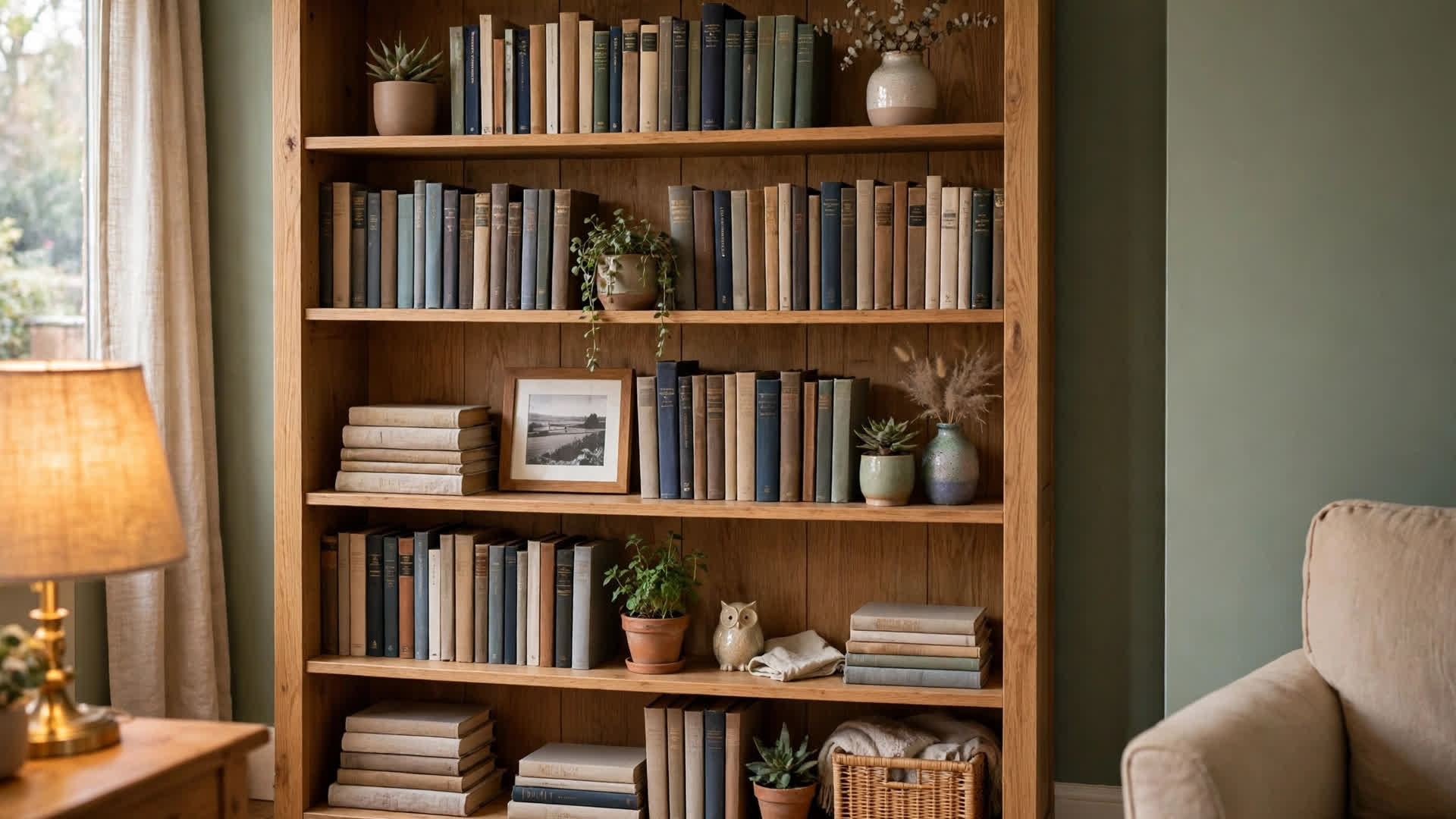
How to Organize a Bookshelf: 10 Steps That Actually Last
Learning how to organize a bookshelf comes down to three moves. Take everything off. Keep only the books you read, love or use. Sort what is left by category, then author. Put heavy books on the lowest shelves, and daily reads at eye level. Leave a little open space on every shelf. This guide shows how to organize a bookshelf step by step. It includes real 2026 UK costs and the safety step most guides skip.
Most bookshelves go wrong for the same two reasons. Too many books get kept out of guilt. The books that stay have no system at all, so every new book lands wherever there is a gap. Fix those two things and the shelf mostly looks after itself. Here is how to do it in one afternoon.
At a Glance
- The short answer: sort by category, then author inside each category. It is the easiest system to keep up.
- Time needed: 2–4 hours for one tall bookcase, including the clear-out.
- Cost: £0 if you use what you have; £30–£80 for bookends, baskets and a light.
- DIY or professional: fully DIY. No tools needed except a screwdriver for the wall strap.
- Biggest warning: anchor a tall bookcase to the wall, especially with small children in the house.
1. Start by Taking Everything Off the Shelves
Every guide to how to organize a bookshelf starts the same way: empty the case. You cannot see what you own while the books are still wedged in rows. You cannot wipe the shelves or check for sagging until they are clear. Work one shelf at a time if floor space is tight. Take the whole case down to bare wood if you have a table to stack on.
Wipe each shelf as you empty it. Dust gathers behind rows of books, and a quick wipe now saves you moving full rows later. Check each shelf for wobble or a bow in the middle as you go. A shelf that already dips needs its heavy books moved lower. It may need a new shelf board before you load it again.
Deciding what stays is the hardest part of how to organize a bookshelf. Sort the books into three piles: keep, move, and let go. Keep the books you read again, use for reference, or truly love. Move the books that belong in another room, like cookbooks that live better near the kitchen. Let go of the rest.
Use a simple test for the hard calls. Would you buy it again? Would you lend it to a friend? Two no’s and it goes. In the UK, good books are easy to pass on. Charity shops take them, and Oxfam and the British Heart Foundation both sell books. Ziffit, WeBuyBooks and World of Books buy or take them by post. Libraries sometimes take donations for their sale shelves. A Little Free Library on your street takes whatever fits. Keep series in reading order as you sort. Keep multi-volume sets together, so they go back as one block.
2. How to Organize a Bookshelf by Category First
Sort by category first, then by author inside each category. This is the system that survives real life. It matches how you actually look for a book. You think “I want a mystery tonight” or “where is the gardening book”. You rarely think of an author’s surname first. Categories let you browse by mood, and authors inside them let you find one title fast.
Give each category its own shelf or zone
Split the keep pile into broad groups. Fiction, non-fiction, cookbooks, children’s books, and reference cover most homes. Big groups get a full shelf each. Small groups share a shelf, with a bookend or a small stack between them. Put the groups you reach for most at eye level and in the middle. The ones you rarely touch go up high or down low.
Then sort by author inside each zone
Inside each category, shelve A–Z by the author’s surname. It sounds fussy, but it takes no extra time once the categories are set. It also stops the slow drift back to chaos. Series stay in reading order, not alphabetical order, so book one sits to the left of book two. If two authors share a surname, shelve by first name next. This small habit is what keeps how to organize a bookshelf working long after the first tidy-up.
3. Pick the Sorting System That Fits How You Find Books
The best system is the one you will still use in three months. Ask yourself how you look for a book. Do you think of the genre first, the author, or the colour of the spine? Your answer points to your system. Most readers end up mixing two: category first, then author, with one display shelf sorted by colour. Picking a system is the step where how to organize a bookshelf goes right or wrong. Pick the one that fits your brain, not the one that looks best in a photo.
| Sorting system | Best for | Watch out for |
|---|---|---|
| By genre or subject | Browsing by mood or topic | Some books fit more than one group, so pick one home and stick to it |
| By author | Finding a specific title fast | Tall and short books side by side can look uneven |
| By colour | A striking display shelf | Hard to find a title unless you know every spine by heart |
| By size or height | Tight shelves and a clean visual line | Less useful when you need one book in a hurry |
| By how often you use them | Daily reads and reference books | The system needs a rethink when your reading habits change |
Colour sorting deserves an honest word. It is the prettiest answer to how to organize a bookshelf, and the least useful one. It looks wonderful in photos, and it works well on a single shelf that is mostly for show. On a working bookshelf it falls apart fast. You have to remember the colour of every spine to find anything. If you love the look, use colour on one shelf and category order everywhere else.
4. Put Heavy Books Low and Daily Reads at Eye Level
Give each shelf a job based on its height. The top shelf holds light books and display pieces you rarely touch. Eye level holds current reads and favourites, the ones you reach for without thinking. The middle shelves carry the main collection. The bottom shelf takes the heavy hardbacks, art books and boxes, where their weight sits low and steady.
Weight is the part of how to organize a bookshelf that most guides skip. A full shelf of hardbacks can weigh 20kg or more. Most flat-pack shelves are rated for around 25–30kg per shelf. Check the manual for your bookcase if you still have it. Spread heavy books across two low shelves rather than loading them all in one place. Heavy books low also keeps the whole case stable, and that matters for the safety step in section 8.
Leave a finger’s width of air above the tallest book on each shelf. Tight shelves look tidy, but books jam and spines tear when you have to drag them out. If your shelves adjust, set the heights to match the books on them. Do not leave big empty gaps above short paperbacks. Wasted height is the most common way a bookcase loses space, and it is the easiest to fix.
5. How to Organize a Bookshelf So It Looks Good Too
A tidy bookshelf is mostly about breathing room. Aim for shelves about 80% full, with the last 20% left as open space. A shelf packed edge to edge looks crowded, no matter how neat the order is. A little empty space makes the books look placed rather than crammed in. The old 70/30 rule is a good guide: about 70% books, and 30% decor and open space. Looks matter too, and this is where how to organize a bookshelf meets styling.
Mix vertical rows with a few horizontal stacks. Vertical rows are easy to browse. A short stack breaks up the straight lines and gives you a base for a small object. A stack at the end of a row works as a bookend without any hardware. Turn one favourite cover face-out per shelf, like a shop display. Change it when you finish a new favourite.
Group decorative objects in threes, and vary their heights so the shelf has shape. A tall vase, a small plant and a framed photo sit well together. Three things the same height look flat. Small potted plants are fine on a bookshelf. Water them at the sink, and keep a saucer under the pot. One overwatering can stain a shelf and warp the books next to it. Faux plants do the same job if you forget to water.
Add light to dark shelves
A little light changes a dark bookcase completely. A small LED strip or a clip-on light costs £10–£25. It makes the shelves glow in the evening instead of sitting as a dark block in the room. Stick to warm white, and keep the cable tucked behind the case. If the bookcase is full and you still have books left over, floating shelves take the overflow. They give you a second display spot on the same wall.
6. Bookshelves in Small Rooms and Rented Homes
Small rooms change how to organize a bookshelf, because every centimetre counts. Go tall and narrow rather than wide. A tall case uses wall space instead of floor space. A slim 40cm-wide case fits in gaps a wide one never will. Think beside a chimney breast, or at the end of a hallway. The top of a low bookcase doubles as a side table. That helps in a room with no space for both.
A bookcase can also split a room. In a studio flat or an open-plan living room, a freestanding bookcase works as a divider. Set it at a right angle to the wall. It marks out a reading corner or a sleeping area without any building work. Leave a gap at one end so you can walk around it. Keep the side facing the room tidy, because it becomes part of the view.
Renters get the best of this job. A freestanding bookcase needs no drilling at all. You can take it with you when you move. It also hides a multitude of sins on a plain rental wall. Wall shelves are a different story, so check your tenancy before you drill. Read our guide to renter-friendly wall decor for no-damage ways to style the wall around the case. If the bookcase lives in a box-room office, read our small home office ideas. They show how to fit a case into a corner without blocking the light.
7. Keep Books Safe from Damp and Sunlight
Where you put the case matters as much as how to organize a bookshelf itself. Never push a bookcase flat against a cold outside wall. Air needs to move behind it, or damp gathers where you cannot see it. Leave a gap of 2–3cm between the back of the case and the wall. Pull the case out once a year to check the wall behind it.
The Energy Saving Trust lists leaving gaps between furniture and the wall among its damp-prevention steps. It also notes that a typical household produces up to 100 litres of moisture a week. Cooking, showers and breathing alone add that much water to the air. The gap behind the case does real work.
Watch for the early signs. A musty smell when you open a book means damp is at work. So do pages that feel wavy, and dark spots on the wall behind the case. Move the case to an inside wall if you can. Wipe the wall down, and open the windows or trickle vents more often. If the damp keeps coming back, the cause is the building, not the bookcase. Find it before it spreads. The Energy Saving Trust’s guide to fixing damp and condensation covers the causes and the fixes in plain language.
Sunlight is the quieter enemy. Direct sun fades spines in a single summer, and the books nearest the window go first. Keep the case out of direct sun where you can. Hang a sheer curtain if the only spot is beside a bright window. Radiators cause the same problem from the other side. Heat dries out glue and paper, so leave a gap between the case and any radiator too.
8. Anchor a Tall Bookcase to the Wall
Safety comes last in most guides to how to organize a bookshelf. It should come first. A tall bookcase can tip forward if a small child climbs it or pulls on an open shelf. A falling case full of books is heavy enough to hurt someone badly. RoSPA advises securing furniture that could be pulled over to the wall. A bookcase is one of the first pieces to fix. Do this step on the same weekend you organize the shelves, not someday later.
Most new bookcases come with a strap or bracket in the box. IKEA includes one with its tall units, and gives out free replacements if yours is missing. Fit the strap to the top of the case and into the wall behind it. Follow the instructions in the box. On a plasterboard wall, fix into the wooden studs behind the board. On brick, use masonry plugs. A strap is only as strong as what it is screwed into. If you are unsure what your walls are made of, ask a skilled tradesperson to fit it.
Renters should ask the landlord in writing before drilling. Child safety is a strong reason, and most landlords agree. Two small screw holes are easy to fill when you leave. If drilling is refused, use a low, wide bookcase instead of a tall one. Keep the heavy books on the bottom shelf. RoSPA’s home safety checklist covers furniture safety alongside the other checks worth doing in the same sweep.
9. What It Costs to Organize a Bookshelf
Cost is the easy part of how to organize a bookshelf. You can do the whole job for nothing but an afternoon. The extras below are worth it if the shelf needs structure or a lift. Prices are 2026 UK high-street and online ranges from shops like IKEA, Dunelm, Argos and B&Q.
| Item | What it does | Typical 2026 UK price |
|---|---|---|
| Bookends, pair | Hold rows upright and stop leaning | £8–£25 |
| Storage baskets | Hide small items and hold paperbacks on low shelves | £5–£20 each |
| LED strip or clip light | Lights dark shelves in the evening | £10–£25 |
| Anti-tip strap kit | Fixes a tall case to the wall | £5–£10, often free in the box |
| New tall bookcase | Replaces a sagging or too-small case | £50–£120 |
| Labels or a label maker | Marks zones on shared family shelves | £10–£25, optional |
A simple tidy-up of a bookcase you already own costs £0–£30. That covers bookends and a basket or two. A full refresh with a new case and the extras lands around £60–£150. Start with the free job first. Buy only what the finished shelf actually needs, because most people buy baskets they never fill.
10. What I’d Do in My Own Home
My own answer to how to organize a bookshelf is simple. I would sort by category, then author, and I would not fight it. Fiction gets the two middle shelves. Non-fiction takes the shelf above. Cookbooks stay in the kitchen where they get used. Up top go the books I love but rarely open. The bottom shelf takes the heavy art books and a basket for the bits that never had a home.
I would spend money on two things only. One good pair of heavy bookends, and a warm LED strip for the top shelf. Matching baskets look lovely in photos. Plain ones from the supermarket do the same job for a third of the price. Nobody sees them once the books are in. I would anchor the case the same weekend, because it takes ten minutes. It is the one job you never want to wish you had done. I would keep one shelf as my reading shelf. It holds the book I am on now, plus the next two in line. I always know what I am reading next.
11. Five Mistakes That Undo a Tidy Bookshelf
These five mistakes undo even the best plan for how to organize a bookshelf. Dodge them and the shelf stays tidy for months.
1. Keeping every book out of guilt. A book you will never read again is not a library. It is clutter with a spine. Let it go to someone who will read it.
2. Filling every shelf edge to edge. A packed shelf looks crowded. It makes every book hard to pull out. Leave 20% of each shelf empty and the whole case looks calmer.
3. Sorting by colour on a working shelf. Colour looks great and finds nothing. Save it for one display shelf. Use category order where you actually read.
4. Putting heavy books up high. Heavy books high up strain the shelf and strain your arms. They make the case top-heavy. Heavy always goes low.
5. Skipping the wall strap. It takes ten minutes. It is the only step that protects a child. Fit it the same day you organize the shelves.
12. Keep It Tidy: The 10-Minute Monthly Reset
A tidy bookshelf needs one rule and one habit. The rule is one in, one out. When a new book arrives, one leaves the shelf, to a friend, a charity shop or the donation box. The habit is a ten-minute reset once a month. The reset is what keeps how to organize a bookshelf working month after month. It is the difference between a shelf that stays tidy and one that slides back in six weeks.
Set a timer and do three things. Return stray books to their zone, because most mess is just books put back in the wrong place. Pull leaning rows upright and tighten any row that has drifted. Move finished reads back to their home shelf instead of leaving them in piles on tables and windowsills. Ten minutes is enough for one bookcase. It stops the small drift that turns into a full re-sort.
Conclusion
Learning how to organize a bookshelf is a one-afternoon job with a long payoff. Sort by category, then author. Put heavy books low. Leave 20% of every shelf empty. Anchor the case to the wall. The system that lasts is the simple one you can keep up, not the perfect one from a photo. Start today with a single shelf, and let the rest follow.
Frequently Asked Questions
Q1. How many books fit on a standard bookshelf?
A standard 80cm-wide bookcase with five shelves holds roughly 120–180 average paperbacks, depending on how thick they are. Hardbacks take more room, so the same case holds closer to 100–140 of those. Measure one shelf and count what is on it. That gives you your own number, so multiply it by the number of shelves.
Q2. Should I shelve books spine-out or spine-in?
Spine-out, always. Spine-in looks neat in photos, but you cannot find a book without pulling it out. Dust also settles into the exposed page edges. Spine-out protects the pages from light, which keeps the paper from yellowing as fast.
Q3. Can I store books in a garage or loft?
It is not a good home for books you care about. Garages and lofts swing between cold and damp, and that cycle warps covers, grows mould and glues pages together. If you have no choice, use sealed plastic boxes raised off the floor. Never use cardboard boxes on concrete.
Q4. What do I do with books too damaged to donate?
Paperbacks can go in your paper recycling once you remove any plastic covers. Hardbacks go the same way after you pull the covers off and bin them separately. Books with mould should be bagged and put in general waste, never donated, because mould spreads to other books. Check your council’s recycling rules first, as a few do not take books at all.
Q5. How do I stop my unread books from taking over?
Give them one shelf and one shelf only, where you can see them every day. When that shelf is full, the rule is simple: read one or move one on before another joins it. A visible pile gets read, while unread books buried across five shelves just gather dust.
Q6. How often should I dust the books themselves?
Every two to three months is enough for most homes. Use a soft brush or the brush attachment on a vacuum. Start at the top edge of each book and work down, then wipe the shelf behind the row. Dust the shelves themselves more often, but the books only need this deeper clean a few times a year.